D1
Chimbulak → Tuyuk-Su bivouac
Departure from Chimbulak station and switch to the Tuyuk-Su basin.
8.6 kmD+ 900 mD− 680 m
Trip journal
A traverse of the Ile Alatau mountains
April 2025·6 days·86.5 km·D+ 6430 m·D− 8080 m
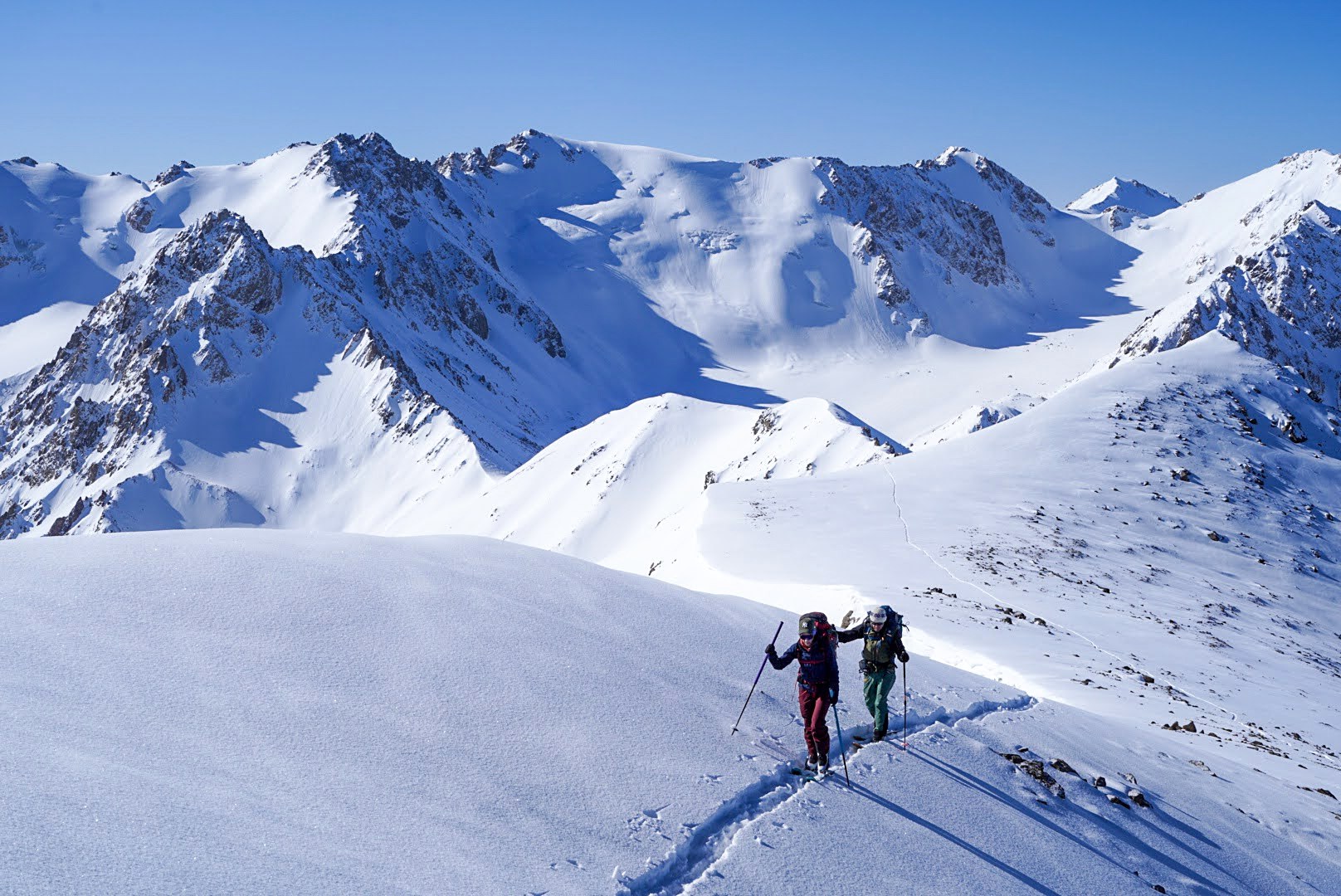
This ski traverse of the Ile Alatau mountains, in Kazakhstan, is an original ski traverse committed to the heart of Central Asia. Between glaciers, basic bivouacs and vestiges of the Soviet era, this journey to ski touring allowed us to explore little-travelled mountains, where journeying requires a careful reading of the terrain and constant adaptation.
More than a simple ski trip, this crossing questions the relationship to commitment, isolation and limits – human as well as geographical.
Information
Itinerary
From Chimbulak to Koklaisay, a line between glaciers, isolated bivouacs and Soviet vestiges.
Interactive map — zoom deliberately limited.
Departure from Chimbulak station and switch to the Tuyuk-Su basin.
8.6 kmD+ 900 mD− 680 m
Passage of the Tuyuk-Su pass and entry into the long glacial valley of Talgar.
11.4 kmD+ 780 mD− 1230 m
Glacial crossing undertaken until the Kuzylsau bivouac.
20.1 kmD+ 1530 mD− 1390 m
Gradual exit from the glacial world and arrival at the astronomical observation station.
15.3 kmD+ 1440 mD− 1220 m
Crossing to the west and last bivouac in the mountains.
12.5 kmD+ 1100 mD− 1100 m
Last stage and exit from the massif towards Koklaisay.
18.6 kmD+ 680 mD− 2460 m
The story
Through the high glacial valleys of Kazakhstan, the mountain guide Yann Borgnet retraces its ski traverse of the Ile Alatau mountains. Unusual encounters, big peaks and little orange huts, and an incident that could have gone wrong: here is the story of a great adventure at ski touring in the heart of Central Asia.
My next-door neighbour is Togolese, expatriated in Burkina Faso, in Ouagadugu. He is a researcher in sanitation systems in developing countries. There is still something intriguing about this mode of air transport, which, with its connections and connections, brings together people from incredibly varied backgrounds.
In his eyes, I am sporty, a big patient when I tell him about our project in Kazakhstan. If I had met him on the return flight, I would have told him straight away that this trip was not easy.
The Chimbulak ski resort does not disorient us, or at least not in the way one might imagine a post-Soviet country. Below, a row of brand-new businesses, photographers who target well-dressed tourists, young women disguised as cosmonauts who try to sell I don't know what to passers-by and large sedans - of course, electric and from unknown Chinese brands.
At the top of the ski lifts, drones fly over the crowds of tourists coming from the city to capture the “Instagramability” of the moment, in front of a “Rolex” four by three. It’s not really the mountain that motivated us to come this far, and yet it is here that our adventure begins, the antithesis of this commodified vision.
We go up a steep cold slope, like an introduction to Kazakh snow science, to a pass topped by a slender gendarme. On the other side, the very rocky southern slope is bare, but the view of the Tuyuk-Su basin gives us the measure of the Kazakh mountains.
In the distance, we see our first bivouac: an orange algeco inside which there are three berths, a table, a non-functional electricity production system and a stove. Aurélien (Lurquin) brought us a bottle of pinot. A large champagne to celebrate a smooth departure, enjoyed in a small stainless steel bowl found on site; here, you don’t need Zalto to appreciate it!
The second day should allow us to move into the Talgar valley, a very long valley where retreat from below would be particularly complicated. We go up to the Tuyuk-Su pass (4015 m) and take a foothold on a large corniced ridge, from which a new section of massif opens up. More rounded mountains, topped with vast bare slopes where black ice surfaces. At the bottom of the first valley, we reach a vast glacial basin.
As is often the case in these configurations, you have to aim for the banks to find skiable canyons. To the left, the south slope, completely cleared of snow, is home to a flock of birds that fly away as we pass.
Our bivouac is the same as the day before, an orange algeco with basic equipment. It is only midday and we have the afternoon to enjoy the silence of this place, cut off from the world, without network or human trace. The most remote point of our crossing.
The outline of the mountains is already tinged with a fine white border, a sign that daybreak is near. Visually, it is really not easy to find the key to the labyrinth caused by the moraine debris. These erratic screes require us to make twists and turns, but there is just enough snow to keep our skis on. I love these situations of perpetual betting on what happens next.
The glacial basin that we reach after passing the clue is vast and topped with impressive glacial peaks, distant and inaccessible. It’s incredible in its immensity and beauty, and I immortalize the moment in a frenzy.
Suddenly, a sign appears on my screen: “unable to save file”… My SD card is dead, and there will be no way to replace it until the Cosmo station, at the very least. A blow to morale.
We continue to go up the glacier in heavy heat. I want to reach a summit on the border with Kyrgyzstan, which would then allow us to switch to a slope that is a priori skiable. But everything is not as simple as on my map and the identified edge, initially comfortable, becomes more tapered and technical. The group's fatigue means it is necessary to recompose the initial plan and cross on the side to the west pass of the said summit.
We reach a comfortable saddle, and, while my companions put on their skis, I set off to reconnoiter. I cross sideways in powder snow, I am relaxed. I reach a small ridge which cuts the slope vertically and marks a change in orientation.
Without being suspicious, I engage the uphill ski in harder snow whose grip seems secure to me. But my downhill ski doesn't bite when I transfer my weight to it. It pulls me along, as if following a step into the void.
My skis then scrape the surface of the snow, discovering blue ice. I feel its small reliefs on my posterior buttocks. I scream. It's endless. I see everything and first of all this protruding stone towards which I am heading at full speed. I try to slow myself down by all means but obviously there is nothing I can do. Just wait and hope you don't hit too hard.
In my attempt to resist gravity, I began to spin head first. Between the approach to the stone and my stop, a few dozen metres further, is the black hole. I stopped because the slope was getting gentler and the snow was cold and soft. I look up towards the source of my fall.
The icy slope was in fact very steep. But in the flat light I had seen nothing, nor felt anything through my skis. Nothing. There is blood in the snow, and I try to work out where it is coming from. My nose is fine. My lips are burning. Most worrying, though, is the pain I can feel in my thigh. I inspect my trousers without noticing anything at first. But they are torn, and the opening matches the rounded corner of my avalanche transceiver. A hole punch could not have been more precise.
My leg is painful and my main fear concerns the femur. If something were ever broken, the situation would become extremely tense. On the one hand because we are very isolated, far from everything, and on the other hand because the bad weather is arriving. I am distracted, incapable of making the slightest decision.
A head emerges from the tricky ridge. It was Thomas, who heard me scream and who immediately understood that I had fallen. Despite the shock of emotion, I am now concerned about how the group will be able to reach me safely. My companions join me by going around the ice slope, crampons on their feet.
Obviously, Amélie is in shock at what has just happened. The hardest part remains to be done: making a decision to cross this damn ridge safely. I have a hard time understanding the map, and the satellite images don't help me much either.
From here, I can clearly see an obvious slope to go up, but what will we find behind it? I feel that I no longer have much energy to manage the group whereas usually, such situations of uncertainty would make me jubilant.
A few kick turns higher, I reach the pass. My first look at the far side confirms my fears. As usual, I run through the kaleidoscope of options before choosing the ‘least bad’. Following the ridge south looks difficult to manage: part of the group is already very tired, and the pain in my thigh is still sharp.
Straight below is much too steep and steep. On the other hand, slightly below, to the right, a snow slope seems skiable. “Seems” because in the meantime, snow started to fall and visibility deteriorated considerably. What the aerial images confirm: in summer, there is a scree there. And in accordance with the laws of gravity, a scree is never very steep.
I take out the rope to secure the entrance to the slope and the first turns confirm my bet, bingo! We soon set foot on the immense Gorodetsky glacier and I am now very focused on finding the best “gravity” line in this particularly tortured terrain.
I compare the imprecise map to aerial images, which are more faithful to the terrain and which make it possible in particular to detect river beds. Visibility is zero and the terrain is particularly complex and tortured, but the cabin is finally reached, with more ease than I feared.
My good Aurélien, faithful among the faithful, willingly accepts the chore of filling the water cow in the stream adjoining the cabin. But when he returns, with his optimistic face that he rarely leaves, he accompanies the removal of the can with a sentence of which he keeps the secret: “nice piss! » Indeed, the water is yellowish, muddy.
Once everyone is dry, we set about cleaning the bivouac, using the now proven technique: several bags of snow are dumped on the ground, wet and muddy, then removed with a rudimentary broom found on site. But the atmosphere remains humid: the ventilation grille has been blocked with a plastic bag, water oozes onto the window and the floor does not dry...
In bed, I have to find the least uncomfortable positions, because in addition to my right thigh, I realise that my left buttocks are also painful under pressure.
Cosmo is an astronomical observation station perched at 3,300m and with two Gamma telescopes still in operation, allowing cosmic rays to be analysed. This place historically depends on the Lebedev Institute of Physics of the Moscow Faculty of Sciences, which also manages two other similar bases: the station on Mount Aragats in Armenia, and another located on the Fedchenko plateau in the Pamir Mountains, in Tajikistan.
There were around sixty people working here at the height of the observatory, but there are only around fifteen at most today.
We rejoin it after a day of slow sliding out of the glacial world, when the grass reappears in large islets and the relief seems to respond to the cry of the ptarmigan. Behind us, the glaciers descended the day before in the fog stretch their pale mass, giving the landscape a striking depth.
The fog envelops buildings inherited from the Soviet era, further accentuating their dilapidated character. A large man emerges from the mist and comes to meet us. He speaks to us in Russian and I respond with a sign illustrating the dodo. “Yann?” » “Da.” »
He accompanies us down a side alley and we enter a period building, closed with double doors. The tiny entrance hall accommodates our skis, next to the kitchen area. A steep staircase with alternating steps leads us into a bright room, which in turn gives access to two blind rooms with, in each of them, an alcove bed. A table and 4 chairs complete the rudimentary equipment of the place.
To Amélie's questions about the highly desired presence of a shower (I had sold them "comfortable" accommodation), he responded with a "niet." » It's so good to be in a heated room that this accommodation, by contrast, seems very comfortable to me. I enjoy the atmosphere of this place. I improvise a shower by hanging the water cow under the eaves of the entrance hall. Warm water on the stove softens the biting cold, while a few flakes linger in the calm air.
A site visit is essential. I cross the main street and reach a large car park where a few cars are parked. I don't really know if I have the right to be there. I approach a man rummaging in his trunk. The pretext of the memory card allows me to approach it. He invites me to follow him. After climbing a wide staircase, we enter a large paneled room where a large billiard table sits. The floor, warped in places, has undoubtedly taken on water.
We continue down a long couloir, from which we escape through a bricked door to reach the upper floor. Up there, the same immense couloir stretches out again, leading to a small room furnished with a desk, a table and a sofa. After heating me a mug of instant coffee in the microwave, he takes out a phone with a cracked glass, extracts the memory card and hands it to me.
I suggest he come and taste the rest of Aurélien’s champagne as an aperitif. Igor is an active retiree. He has been a mechanical and electronic engineer on gamma telescopes since 1983 and maintains them, generally staying here for periods of 15 days.
After Igor leaves, Amélie retreats and I sense something is happening. She needs to be alone, she tells me. At the meal, the atmosphere is heavy. I can see that this is not going well. So I start the discussion: “Are you upset about the trip? ". His last question to Igor was about how to get off from Tian-Shan station: 23 km on foot. This lack of alternative weighed on her, even if deep down, Amélie is a fighter who is not used to giving up. But she feels cornered with the unpleasant feeling of delaying us.
She also needs to plan for the remaining steps. As a guide, we focus on the uncertainties linked to mountain conditions, perhaps sometimes obscuring human uncertainties, which are paradoxically easier to resolve, provided we provoke such moments of exchange. One thing is certain: this evening, everyone goes to bed with a lighter heart!
The sun rises over Tian-Shan, and its dominant position expands the expanse of the mountains of Ile Alatau. A providential snow bridge allows us to cross the torrent to switch to the opposite slope. The horizon opens onto the Kazakh plain and its economic capital, Almaty, from where we left. The atmosphere is lighter today and the descent is delicious.
In the distance, we see our little cabin. It is a small sheet metal construction, with a gable roof and a small chimney. Aurélien jokes, wondering if we will be able to lie down. Surprisingly, it is rather modern in its construction: floor to ground, wall lining with wood-look plywood, double-glazed window. The bed bench is wedged under each foot but still far from being flat, and the door has disappeared, replaced by a wool blanket.
Sitting in our sleeping bags, we read, write, discuss, and sometimes we do nothing. It is not a question of waiting, since waiting means that there would be an end to reach, an outcome of something or an objective to fulfill. The almost imperceptible rustling of the snow which delicately settles on the tin roof of our small shelter adds an almost unreal sweetness to the silence.
Perhaps we express the hope, in each of us, that this time stolen from our frenetic existences will never end or be disrupted by any obstacle. This is our last evening in the Kazakh mountains. It is joyful, because all these adventures have often made us doubt the outcome of the journey. But it is also tinged with nostalgia, these passages of life being ephemeral, a condition of their existence and the incarnation of a cherished rarity.
Tomorrow, we will finish our crossing at a beautiful summit dominating the immense Kazakh plain, as far as the eye can see, from where we will be able to measure the distance covered. Then there will be the slow descent, literally and figuratively, which I know is long and uncertain. We will meet Kazakhs who are intrigued to see us arriving from mountains that are inaccessible to them in winter. They will offer us a bowl of soup as a mark of hospitality abroad. Then we will go and get drunk in the bars of Almaty to forget this brutal return to modern civilisation.
As a guide, I have achieved with this journeying both the embodiment of what I want to experience as a professional and a limit of what I am ready to accept as an engagement with clients. This trip pushed me to my limits and the accident probably strongly colored this feeling. But in the end, what a journey!
Portfolio
A traverse of the Ile Alatau mountains
LES GRANDS RAIDS À SKI