D1
Stavros Refuge → Kalarites
Passage through Nereda and Matsouki before reaching the village of Kalarites on foot.
28.7 kmD+ 1840 mD− 1740 m
Trip journal
From Tzoumerka to Smolikas
End of February 2026·7 days·161.9 km·D+ 11460 m·D− 11880 m
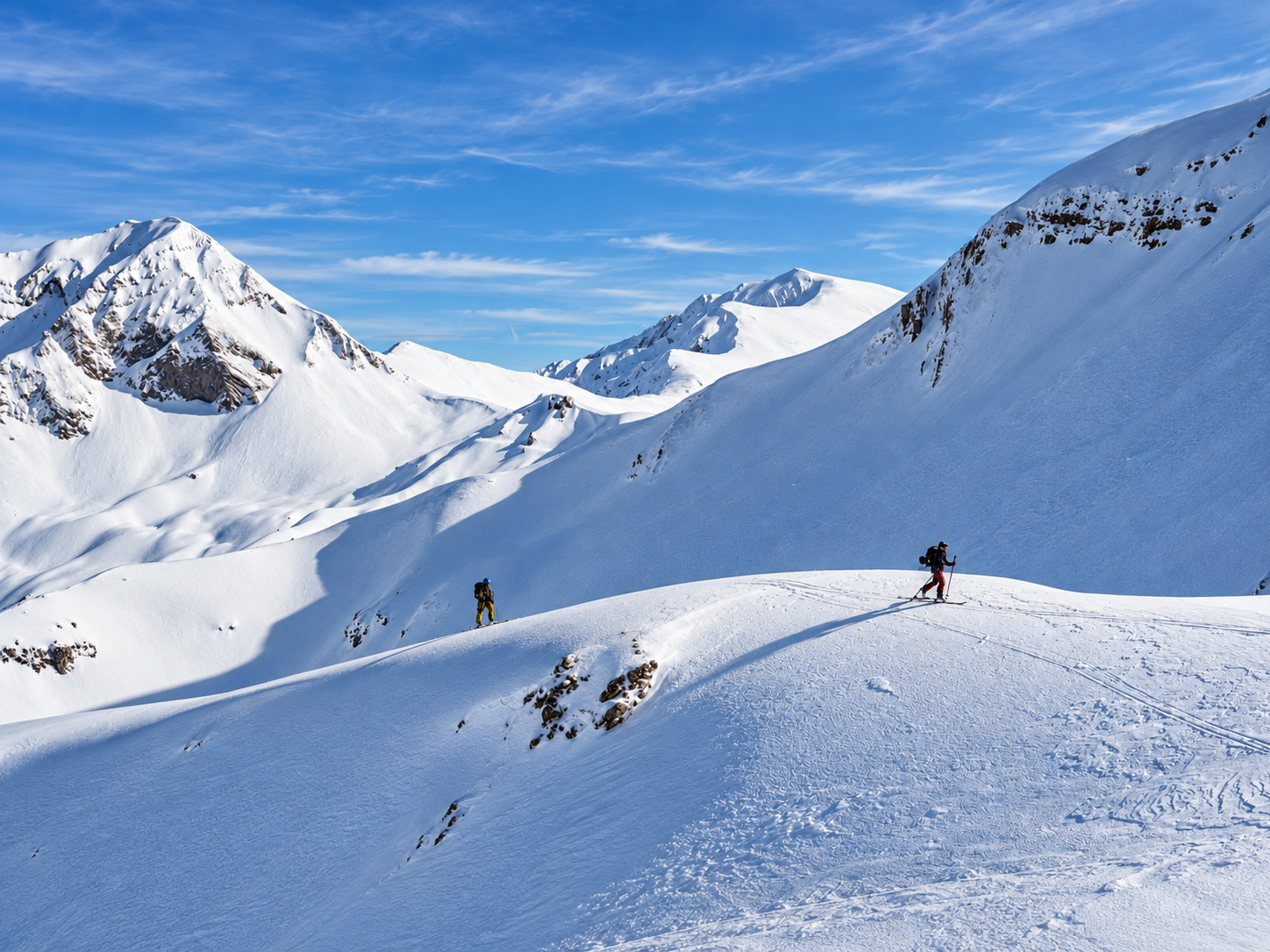
Skiing in Greece. In the collective imagination, it is neither a country of snow nor a country of skiing. This is precisely why I wanted to go there: for the improbable, the unexpected and the doubts.
We chose to reach Epirus without a plane, by train then by ferry. Then come the Tzoumerka, steep and mineral, its stone villages and its hanging monasteries, then the Pindos, gentler, with their long ridges and their century-old pines. Seven days of crossing to Smolikas, the second highest peak in Greece, for a journey about which, just a few days before departure, I was sure of almost nothing.
Information
Itinerary
A crossing of the mountains of Epirus, from the mineral reliefs of Tzoumerka to the long wooded ridges of Pindos, to the second highest peak in Greece.
Interactive map — zoom deliberately limited.
Passage through Nereda and Matsouki before reaching the village of Kalarites on foot.
28.7 kmD+ 1840 mD− 1740 m
Baros Pass, summit of Kalogiros then Souflomiti SE, before the descent to Matsouki.
24.5 kmD+ 1820 mD− 1810 m
Crossing Lake Noss and the Balcaz massif, then long descent to Anthochori.
20.3 kmD+ 1390 mD− 1500 m
Entrance into the Pindos via the long ridges of the Valia Kalda, between beech forests, century-old pines and rounded peaks.
30.6 kmD+ 1880 mD− 2110 m
Long crossing of ridges to the Vasilitsa station, following the areas still covered in snow.
18.7 kmD+ 1520 mD− 1010 m
Summit ridges, Orthodox chapels and long descents between the pines before reaching Samarina.
16.7 kmD+ 1190 mD− 1630 m
Ascent of Smolikas, the second highest peak in Greece, then final descent towards Pades to complete the crossing.
22.4 kmD+ 1820 mD− 2080 m
The story
4 a.m., the alarm rings. I know it's going to be a long day because to get to Greece, we chose not to take the plane. Not taking a plane means combining several modes of transport. First go to Novara by car, and leave the car there to take a first train then a second train to Brindisi, in Puglia, in the very south of Italy. Then, if all goes well, we will board a ferry which, during the night, will take us to Igoumenitsa, a Greek port located in the northwest, in the region of Epirus.
From there, a few more hours by taxi, and we will finally be able to put on skis, in the south of the Tzoumerka massif, located to the south of the Pindes massif.
Obviously, everything doesn't go as planned. We had planned to leave with Aurélien's car, an old Scénic from the early 2000s. But after a few kilometres, it faulted. We pick up Aurélien, leave his car there, and finally leave with Osman's.
A few kilometres from the Mont-Blanc Tunnel, a notice board indicates: “Tunnel access road closed, avalanche shooting”. It snowed last night, once again, and the risk of avalanches in the French Alps is maximum. New cold sweat at the idea of not keeping the schedules. After a few minutes of waiting, the line of cars starts moving again. The barriers rise, traffic resumes, and we pass without incident.
In Novara, the small car park I usually use is full. Another uncertainty. We end up finding a place to leave the car. Regional train to Milan. Three takeaway pizzas from a bad pizzeria near Milan Central Station. Then we look up at the building, massive, monumental, almost overwhelming. A stone architecture that imposes more than it welcomes.
Seven hours by train to southern Italy. I'm jubilant. I like this slow way of travelling.
In Rimini the train stops. A long time. Then a message: for reasons of judicial investigation, traffic is interrupted for two hours. Someone threw themselves under the previous train — rest their soul — but, for us, that complicates everything. Quick calculation: it's going to be tight.
The train leaves. I still hope. A call to the ferry company puts an end to the illusion: you have to be there at least an hour before departure. With our delay, it's impossible.
I book a hotel in Brindisi. I'm reorganizing. I inform the group. I book them a taxi so that they can reach the start of the first stage without us.
The next morning, we took advantage of this forced stopover to visit Brindisi a little. Then head to the port, after buying some rusticos and pasticciotti. The crossing takes place on rough seas. Given the expected arrival time and the three-hour drive to Tzoumerka, I decide to sleep in Igoumenitsa.
Departure before dawn the next day to join the clients and attack the first stage of our crossing of the Tzoumerka. More than 2000 metres of altitude difference. Objective: Matsouki, then on foot, skis on your back, Kalarites.
For several days, I have doubts about the snowfall. Impossible to clearly read the boundary on satellite images. This first step is decisive. I only reserved this first part; the rest remains conditional.
7 a.m. Stavros Shelter. Small perched hut, view overlooking the valley. Reunion with the group.
In Nereda, not a single living soul. Around 1500 metres, facing south, we put on our skis. Good sign.
The forecasted clear sky closes quickly. Fog. First pass, then second, without visibility, barely the tips of the spatulas. Then the clouds part. Light. Easy snow. Great curves. At 1500 metres, the snow ends, both in the north and in the south. Odd.
Long walk to Matsouki. An elder greets us. In the square, a big fire: it is the period of Apokries, the Greek carnival preceding Lent. Costumes, music, fire in front of the chapel.
Paved path, monastery suspended above the valley. Then descent towards Kalarites.
19:00 First beer. Four hours of walking with skis on your back.
We sleep at Napoléon Zaglis’s house. A man who must probably be in his seventh decade, with a stocky figure, with his laughing eyes and his thick mustache that marks his face. With his wife, they run a restaurant-grocery store and a few rooms. From the outset, we felt a warm welcome, from them and from their employee, who also had a laughing look. When Thomas asks him for “Isabella” wine, a marketed and conventionally produced wine, his reaction is immediate: “we don't have this wine, it's illegal to serve that!” ". All this to say that at Napoléon, only good products come in!
The dishes follow one another, and the table is soon covered with garnished plates: Greek salad, seasonal salad, meats of all kinds, cheese.
In the square, the party continues. A huge blaze, the name of the village cut out in large letters in front of the flames. Traditional music rises: almost oriental sounds, catchy, hypnotic. Greeks extend their hands to us and we soon form a circle. We are caught up in the dance. Hand in hand, we circle around the fire. We are handed a glass, a plate. Impossible to refuse.
Clearly, these Greeks have generous souls.
The room is dominated by old dark woodwork, weathered by time. Wood frames the windows, clads the walls, makes up the headboard. A light smell of resin still floats. Simple, massive furniture. Nothing superfluous. We feel the mountains and past winters.
This morning, it is Napoleon's wife who serves us breakfast, and when her husband arrives in the room, we feel that love among them does not erode over the years.
We set off again on the asphalt road which goes up to the Baros pass, then we leave it for a path which soon gets lost in the bushes. The shortcut isn't saving us any time this morning. We emerge on a small promontory, where a chapel dominates the entire valley. We are ringing the bell! Like the day before, we climb to 1500 m, then go up a rounded ridge to the summit of Kalogiros (2088 m).
Today, we have little effective distance, so we take the opportunity to do a little skiing. The snow is particularly good, a small layer of powder on top of a hard bottom. And safe!
We go back down the large eastern slope of Kalogiros, then go back up to Souflomiti SE. The next two valleys, due north, delight us. I was afraid that the snow had started to transform in the north, but that this transformation would be partial and that we would be skiing bad crusty snow. But there were two days of good weather the previous week, then another small snowfall the day before our arrival, stabilizing the snow conditions and making skiing pleasant! And despite the heat, this powder doesn't move, surprisingly!
After having carried the skis quite a bit the previous two days, this time we went down and back up on foot in the same valley. So we literally empty our bags and head along a forest track to the village of Matsouki, reached just as the public lighting begins to illuminate the stone streets. A sign reads “La Verliga, radio”. Christos Zacharis, the owner of the bar-restaurant of the same name, is also a journalist and host of this web radio, in the Aspropotami and Vlach languages.
We enter a dark room, lit by fairy lights, and with a stone slab floor. A big white dog sits there, in the middle of the tables. The benches are covered with long-haired fabrics, customary for these places. The beers are followed by numerous dishes, always very salty (as is often the case here!): tomato salad, meatballs, beef and pork, pieces of lamb, cheese...
Then it's time to go to bed. Thomas, who had spoken with Christos, seems to say that we are going to sleep in different houses in the village.
To Amélie's pressing and slightly worried questions, Christos shows us the different benches that cover the entire walls of his restaurant. Benches around thirty centimeters wide, on which small moss and these famous long-haired blankets are placed. We think he's joking. But quickly we understand that we will have to sleep in this room.
We each take turns testing the benches. They are really narrow and the little foam is very fine; it does not completely absorb the hardness of wooden benches. So we are reorganizing the restaurant room. We push the tables and install these little moss on the ground, a layer of moss on the stones that make up the floor, and the long-haired blanket on top. Four small foams in width, approximately 1.20 m, constitute a double bed.
We sit around the stove and Thomas and Mathieu will work all night loading it so that it continues to heat us.
The night wasn't so bad, well maybe not for everyone. Christos' big white dog slept with us and, excited in the early morning, rubs against each of us as a morning greeting.
We go up to the small pass, but when we get there, Aurélien has disappeared. He followed me though. The group had stretched out a little, each walking at their own pace on this trail covered the day before. The minutes pass and Aurélien does not show up. Surprising without really being so. We know Aurélien, quick to lose his things and sometimes to lose himself. It’s Aurèle, he’s like that, and we adore him like that.
After half an hour, I decide to call him. He has already climbed up to the snow twice without finding us. I send him my location on WhatsApp, tell him to turn on Google Maps, and soon he's back on the right path.
Christos' dog followed us. He seems happy in the snow, covering three times the distance we cover. But the gusts of wind sting his eyes and whip his whiskers.
From the pass, we go through a somewhat steep valley then go up to the summit of Lake Noss, the highest point in the north of the Balcaz massif. Some steep passages complicate the dog's progress. I would prefer him to return to the village rather than to fall with us. A crossing that is too steep will destroy its capabilities on frozen snow. We lose him here, hoping he comes back down to his master.
On the other side, a beautiful valley offers us delicious snow to ski. But around 1500 metres, you already have to put your sneakers back on. A path not indicated on the map takes us back to Anthochori, the last stop in this wild massif and ideal for skiing. In three days, we didn't come across anyone, only a trace of a snowshoe.
Hélène welcomes us warmly. Three bedrooms: two for couples, one for singles. She is not normally allowed to cook for customers, but due to the lack of an accessible restaurant, she prepares us a meal, asking us to remain discreet. She seems happy to let us taste a local specialty.
Later, we cross the road to go for a drink. A stove sits in the middle of the room with long horizontal tubing and 90-degree elbows that would make French standards falter. Here, we keep the heat in. Behind us, some elders are smoking. When we return, our clothes smell strongly of cigarettes.
A message to Christos: his dog still hasn't come home. This worries us. Had we made the right choice?
The next day, we leave for Pindos. The relief is gentler than in Tzoumerka: rounded mountains, endless ridges. Copernicus satellite images make me change the route to avoid a snow-free area. We advance from ridge to ridge.
The beech trees dominate at first, then higher up the twisted pines appear. Most are headless, they have lost their heads, sculpted by the storms. These pines are majestic.
After almost 2000 metres of altitude difference, the sun sets. We decide to go to the top for bed. Up there, a small white chapel and, as far as the eye can see, the Greek mountains bathed in orange light. It's cold but the beauty of the moment makes us forget it.
The descent is incredible: a few centimeters of powder on a hard bottom, smooth terrain, then a dense beech forest.
We are picked up at the pass to avoid the long asphalt road to Périvoli. Running downhill, at night, with the lights of the village in the background.
In the large glass room of the restaurant, two stoves heat the room. More dogs. The meal arrives: tzatziki, Greek salads, meat in sauce with rice. Perhaps the best cuisine of the stay.
The owner tells us about their life here, seven months a year in the village. Everything was built by her and her husband. Their passion became their job. She speaks with pride about Valia Kalda and her attachment to the territory.
The next day, long ridge to connect Périvoli to Vasilitsa, the only passage still covered in snow. A small northern valley offers us a few bends before an endless climb towards the summit above the station. From there, we easily reach the pass and the station.
I had originally booked in Smixi, but Yanis' injury complicated the logistics. Finally, we sleep at Vasilitsa 1850, a hybrid between resort hotel and hut, in a dormitory.
The catering system is special. You have to choose carefully: excellent bean soup, good veal with tomato-lemon sauce, uneven burgers. However, several of us were delighted to return, for one evening, to our Western dishes.
Yanis is very nice, he lived in Chamonix during Covid. Panos seems gruff, but we won't stop at that first impression.
Here, we are far from the mountain hut where the conditions of the mountain guide the waking time. Here, we have to deal with the pace of the ski resort, and there is no possibility of breakfast before 8 a.m. And always this weird order-taking system, à la carte but where the menu is only available from the mouth of the owner. Fortunately the day is short and we are not in too much of a hurry. Ultimately, this “transition” day will be longer than expected!
The first climb ends on a magnificent corniced ridge, which allows us to reach these small Orthodox chapels typical of certain Greek summits, modest constructions dedicated to a saint and often erected at the highest point, as a discreet sign of the link between the mountain and the sacred. The descent, on perfectly spring snow, turns into a slalom test between the pines, which are more or less densely planted. I understand from the excitement of my companions that they want more. So we go back to the summit in the blazing heat.
From there, two options were available to me: either respect the line drawn the day before, which seemed to be optimized to prolong the slide as much as possible based on the latest satellite photos of the massif, or let yourself be caught up in the slope, and then take notice. Obviously, the second option quickly won out, plunging us into an awkward situation. A good quagmire in prospect, unless you cross a hilly and tortured slope on the side. Scratching won't be enough, and we'll have to re-skin, causing some protests within the group! Fortunately, a picnic spot overlooking the valley awaited us at the summit!
The rest of the descent is no smoother, and we quickly give up. Swapping skis for sneakers doesn't help us, however. The path is below but a section of dense and steep forest separates us from it. I am not unhappy to find the yellow dots, surrounded by a red circle, which mark the paths here. We join a path on the mountainside, traced among century-old pines. At a quarry, one of them, enormous, even stands on two legs, perhaps resulting from the fusion of two pine trees.
Since the beginning of our stay here, we have noted with desolation the consequences of the autumn floods, which ravaged Epirus. Here, the bridge which was to allow us to cross the river has disappeared, forcing us to test, at least in part, its temperature.
We finally arrive at the monastery, the same one that seemed so close to us a few hours earlier. From there, two teams are formed: those that our host comes to pick up by car, and those who walk, or run, without their backpacks.
We arrive in Samarina, a fairly large village, where most of the houses have their shutters closed. Right next to the Guest House, a large building covered in red steel appears to be a church. There, on the roof of a small annex, a large pine tree grows, symbol of this massif where this tree grows supreme. An old black and white photo, probably on film, shows this same tree and priests in cassocks. Surprisingly, it does not seem to have grown that much since this period, perhaps revealing the slow growth of these trees, some of which must be several hundred years old. The owners of the Guest House also run a restaurant downtown, where they accommodated us for dinner.
Paradoxically, the centre of Samarina is lively. Several restaurants surround the central square. Fortunately Mike comes to meet us, because we could have quite easily entered the wrong address. At the entrance to his tavern, a lamb butchered and hung by its back legs provides the framework for what is offered on the menu! A priori, we are going to eat meat this evening. We give Mike carte blanche, and soon the table is covered with many dishes, so that the tablecloth becomes invisible. Tripe, lamb, beef and pork, and a few side dishes, incidentally.
For the first time since the start of the crossing, a real wine list will allow us to discover this element of Greek culture. We compare Pinot Noir and Tannat, grape varieties quite widespread in Europe, with Xinomavro, an indigenous grape variety which enhances a wine produced biodynamically. A favourite for the team, and first of all for our demanding winemaker!
Last day, and not the least, since we plan the ascent of the second highest peak in Greece, Smolikas. For once, we insist a little more than usual to be able to have an early breakfast. I told Panagiotis that we will be at 15:00 at the meeting point, on the other side of the Smolikas.
Samarina is relatively high and, at almost 1500 metres above sea level, this village offers us the possibility of leaving almost on skis.
The Smolikas appears as a long summit ridge, punctuated by several successive peaks. The game of the day will consist of scraping as much snow as possible to avoid covering these distances on foot. So, as soon as we reach a high point and a slope lends itself to a very rapid descent, we let ourselves slide to reach the next summit.
At the end, a short distance from the highest point of the ridge, the spring snow is so good that the scraping turns into a beautiful descent. A descent that we will pay for at the price of the difference in altitude to go back up, but that is the game of the ski touring.
And there we are, we are all gathered at the summit, at the summit of this week-long crossing through the Epirus Mountains, an incredible crossing. I wasn't sure of anything when I plotted this route, and I was even less sure a few days before departure when I saw the snow line so high.
This is probably the trip that required the most preparation, both because the Greeks have this annoying tendency to not respond to messages when they use encrypted messaging, and because, for many others, it is almost impossible to reach them other than by phone or SMS.
From here, we see our starting point: Kakarditsa, the highest point of the Tzoumerka massif, at the foot of which we passed a few days earlier. It seems far, immensely far. And then, a little closer, these rounded mountains which mark the southern entrance to the Pindes massif.
There remains the descent, which once again does not seem entirely obvious. The game, as from the beginning of this trip, consists of optimizing the snow limit as much as possible, scraping the snow where it remains and skiing down almost at all costs.
But in this game, we never win below 1500 metres of altitude. It is by a path evolving through southern vegetation that we finish this beautiful crossing, and find Panagiotis in the village of Pades.
We drop off our companions from the southwest in Ioannina, with a quick goodbye in view of these good times shared.
Portfolio
From Tzoumerka to Smolikas
LES GRANDS RAIDS À SKI