D1
Entracque → Casterino
Vallon d'Ischietto
From Entracque, climb through the Ischietto valley - wild terrain, large avalanche deposits crossed along the way - then first switch on the French side to Casterino.
20.5 kmD+ 1780 mD− 1320 m
Trip journal
Traverse of the massif
Early April 2026·7 days·121.9 km·D+ 11850 m·D− 11980 m
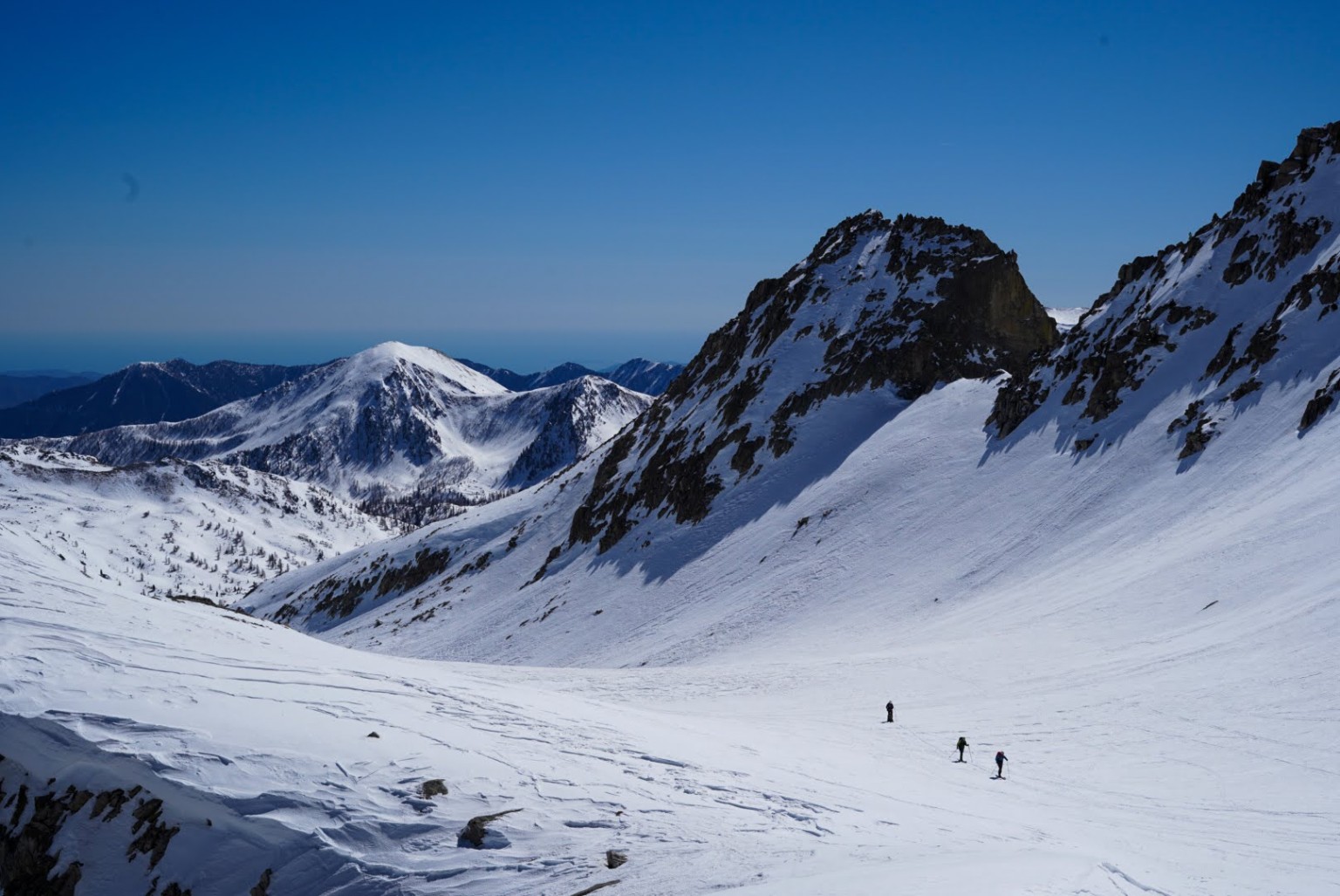
The weather being disturbed in the Tödi then in the Silvretta, I fell back on the Argentera, a massif already crossed in 2015 then found again in 2024 and 2025 during my crossing of the Alps.
Seven days from Entracque to Sant’Anna di Valdieri, via Casterino and the huts of Nice, Cougourde, Remondino, Valasco and Livio Bianco. A range well suited to a ski journey, with abundant snow this year and room to put together gentle or committing days. Above all, around the bend on one stage, my first encounter with wolves, in broad daylight, just a few dozen metres away.
Information
Itinerary
From Entracque to Sant'Anna di Valdieri, a transalpine crossing via Casterino and a succession of huts open in winter.
Interactive map — zoom deliberately limited.
Vallon d'Ischietto
From Entracque, climb through the Ischietto valley - wild terrain, large avalanche deposits crossed along the way - then first switch on the French side to Casterino.
20.5 kmD+ 1780 mD− 1320 m
Baisse de Fontanalbe · Baisse du Basto · Mont Clapier
From Casterino, almost in a straight line via the Baisse de Fontanalbe then the Baisse du Basto, in the wind and the snow carried. The route also passes by the summit of Mont Clapier (3045 m), calm despite the wind, before reaching the Nice hut.
20.1 kmD+ 2170 mD− 1500 m
Épaule du mont Gélas · Pas des Ladres
From the Nice hut, climb towards the shoulder of Mont Gélas (around 3093 m, below the summit at 3143 m), then switch via the Pas des Ladres to the Cougourde hut, with a possible escape towards the Cima Gaisse.
21.6 kmD+ 2300 mD− 2410 m
Cima dell'Agnel · Passo di Brocan
Switch to Italy via the summit of the Cima dell'Agnel (2932 m), then descent overlooking the valley of Lake Chiotas, before a second pass, the Passo di Brocan (2892 m), to reach the Rifugio Remondino.
13.0 kmD+ 1680 mD− 1330 m
Cima di Leccia · Col de Cerise · Baisse de Rogué · Tête des Bresses Sud
From Remondino, climb to the Cima di Leccia via the Cerise pass, then cross the Baisse de Rogué and the Tête des Bresses Sud, before descending to the Valasco hut, the former hunting pillbox of Victor-Emmanuel II.
18.7 kmD+ 1620 mD− 2330 m
Colletto Est della Paur
From Valasco, crossing the Colletto Est della Paur (2890 m), the only clear highlight of the day, between high valleys and Italian huts, before reaching the Rifugio Livio Bianco.
13.3 kmD+ 1400 mD− 1280 m
Cima del Latous
Last stage: passage through the Cima del Latous (2744 m), then long descent towards the valley to reach Sant'Anna di Valdieri and the end of the transalpine crossing.
14.7 kmD+ 900 mD− 1810 m
The story
This morning, there is an atmosphere that is both light and serious. Light because it will probably be necessary to improvise, and this dose of uncertainty which does not allow us to plan ahead opens up the field of our possibilities. It opens the day with intoxicating unknowns.
Serious, because we are silently aware of the conditions that await us once we pass through the door. No promises today. We are the first to leave the shelter. Outside, it is snowing and the wind is gusty. Every inch of my face is covered. Only the eyes, through my glasses, can see.
I think of these women who cannot breathe freely through their noses. To Afghan women and all others. I think of the Taliban, who so quickly took over the reins of a country that was nevertheless on a path to freedom.
“There’s someone at the pass!” », I exclaim. A slender silhouette, a bag on its back, stands in the indentation, projecting its being into the whiteness of the sky. Where could it come from? The other side is even wilder than the one we are going up. And no, the illusion doesn't last long. It's a sign. I am both disappointed and happy. Happy to know we are alone in this mountain which doubts the validity of our presence.
On the other side of the pass, the Figari hut, closed at this time, and the Chiotas reservoir give the feeling of a reassuring presence. However, they are inanimate concrete beings. Inert things. But they serve as landmarks, and probably also as shelter in the event of an unforeseen event.
The tour of Kaçkar, in Türkiye, turned into a Rätikon-Silvretta crossing, in Switzerland and Austria. Because of Trump and his senseless war in the Middle East. And the Swiss trip has become transalpine for a legitimate cause of the mountaineer, almost a refrain in this particularly snowy winter of 2026: the weather.
One, two, then three negative answers for the shelters. Back to the start. And why not do the crossing in the other direction? Very often, it is in these kinds of constraints that the greatest opportunities appear.
It will therefore be a crossing from Entracque to Sant'Anna di Valdieri, passing through Casterino and the huts of Nice, Cougourde, Remondino, Valasco and Livio Bianco. And if possible deviating from obvious lines. With the barely hidden objective of seeing the wolves of Argentera again.
Between the Livio Bianco and Valasco shelters, a few days before, with Alexis, Géraud and Laurent, I finally saw the wolf. A trio, surprised to see skiers sliding down, and in turn sliding down the slope. Furtive encounter, pleasure consumed but surely not shared with these individuals who usually do not make themselves seen.
We will come across traces from the first day, at the entrance to the Ischietto valley, leaving the Sabbione valley on the left. A vast steep and hilly slope faces us. At the intersection of these two options, no one wanted to decide between the peaceful option of Sabbione and the more adventurous option of Ischietto. So, in the absence of votes for the easy option, I decided for the unknown.
A hole in the snow, stained with blood on its edges. At the bottom, a butchered chamois, whose legs are still very fleshy, with pink meat. Obviously, the feast was eaten, and the remains were placed in a cool place. A little further on, we cross a huge avalanche deposit. As I climb up one of its side slopes, I am suddenly surprised by an unexpected flight. A golden eagle has just deployed its full wingspan just below me, while it was busy tearing the neck of a dead young chamois. So many encounters!
With Gilles, we share the trail. Soon I see it disappear in the swirls of snow carried by the wind. An unpleasant preview of the conditions we will have to face over the next few days.
Casterino is a seasonal village. Around ten buildings, and almost half tourist accommodation. Against all expectations, snow covers all the surrounding slopes. A decade since Paul has seen this much snow, this late in the season. Resolutely the year of Mediterranean skiing, in all its latitudes.
The sea will be our backdrop for the days to come, a deep, infinite blue horizon, contrasting with the snowy slopes and pine forests.
We feel the Pre-Alps, the mountains resemble hills, soft shapes covered with larch trees. The wind picks us up as we leave the forest, never to let go. There is no longer any question of making detours to reach the Nice hut: Baisse de Fontanalbe and Baisse de Basto constitute almost a perfect azimuth.
We think we are protected by placing ourselves under the prevailing wind. A sort of canyon, bordered to the north by a cliff, could be saving. But the wind is so strong that it turns alternately in all directions, without giving us the slightest respite. We are like the characters in La Horde du Contrevent, forced to develop collective strategies in the face of this element which little by little imposes itself as the heart of the experience.
At Mont Clapier, there is almost no breath of air, and the horizon extends to the sea.
All night long, the wind tried to make the shelter vibrate with gusts. But even the strongest among them did nothing to this stone construction with its thick walls. I like to feel the elements unleashed, thus protected. They are close, perceptible, but they do not reach us.
Christophe is entering his twenty-sixth year of guarding the Nice shelter. A quiet strength, with his coarse mesh cap screwed on his head. Here, as in La Cougourde, you have to be determined and love your job to welcome winter. Half a thousand nights, without running water and without the possibility of helicopter transport to transport food, due to the national park.
We set off again amid the squalls, towards the shoulder of Mount Gelas. Certain gusts instantly stop the slightest movement and the “downwind” nature of the place has little effect. But once again, by an incomprehensible physical mechanism or the action of I don't know what divinity, the wind stops at the summit.
After a few hours during which everyone retreats into their different protective layers, where everyone follows the rhythm imposed by the wind, we reach the Cougourde hut. By switching behind the Pas des Ladres, the vegetation appears denser than before. A southern forest that mixes pines and larches, an ideal terrain for wolves.
As I leave again, still in the same quest to tire Gilles, towards Cima Gaisse, they will see them, the wolves. Right opposite, from the small windows of the shelter. A trio, like the previous week.
As for us, I will not hesitate to look for the key to the entrance to the northwest couloir. After trying to get back halfway up the slope, finding myself above a small continuous rocky bar, then trying to follow the dotted blue line indicated on the map, finding myself again above high bars, we resigned ourselves to putting the skins back on to attempt access from the summit.
Access to the couloir is more obvious from here, although some doubt remains since a large rock seems to block access to the lower part. It just passes, and the rest is delicious to ski. On our way back, some news, and what news! Three wolves passed by, in broad daylight, right in front of the shelter.
Quentin, almost thirty years old, has been a winter caretaker since this year at Cougourde. Only the small stove warms the room. Here too, opening in winter requires loving your job.
Today, we move to Italy, for the second half of the raid which I decidedly thought was transalpine, since three huts are guarded: Remondino, Valasco and Livio Bianco.
A beautiful couloir did not initially appear obvious to me, and its presence allows you to switch to Lake Chiotas with a certain logic, auguring a beautiful descent from the Cima dell'Agnel. The wind has subsided, but it welcomes us at the summit in an icy manner, before falling completely silent in the valley of Lake Chiotas.
For once, we reach the shelter early. Remondino was not on the initial line: one option among others in the kaleidoscope of possibilities.
After a small couloir climbed up with crampons, cold windy snow, hard and compact underfoot, we actually arrive at the Cima di Leccia. The sea, from here, becomes the main horizon of our gaze. On the opposite slope, the snow has taken the Mediterranean sun, its surface is hard, almost icy. And the steep slope.
I make two short, jumping turns only to realise that it is not reasonable to have my clients ski down here, even in a skid. The grip is not good enough, there is no room for error. There is no more rational calculation, only an intuition which tells me that it would not be reasonable.
We reach a slope with gentle slopes, covered with pine and larch forests. A land of wolves. And indeed, the clues do not have to wait long. Several parallel traces, characterized by large pads, descend the slope of the Basse de Rogue.
One last look at the sea from the head of Bresses Sud, and we dive into the opposite slope. The wind blew too much, making the coat sometimes hard, sometimes uncertain for support.
Valasco, a strange hut. Former hunting casemate of Victor-Emmanuel II, two towers mark the entrance to a large interior courtyard, like a riad. Tables and deckchairs are an invitation to beer. There is a special atmosphere there: the conviviality of reunions after a good day of skiing.
After a varied plate of antipasti, a table is set up just behind the bar. Large bowls and half a wheel of gorgonzola take place there: one is filled with polenta, the other with the traditional salsiccia in umido dish, including sausages in tomato sauce. As in the self-service restaurant, everyone comes to help themselves as they wish after Andrea has garnished each plate with a generous ladle of polenta. This little nothing livens up the room and gives a joyful atmosphere.
Portfolio
Crossing from Mercantour to Argentera
LES GRANDS RAIDS À SKI