D1
Vermosh → Lëpushë
First entry on skis into the Prokletije, between wooded ridges and slopes of Maja e Grebenit.
18.3 kmD+ 1010 mD− 760 m
Trip journal
A traverse of the Prokletije
Early March 2026·8 days·182.2 km·D+ 11280 m·D− 10860 m
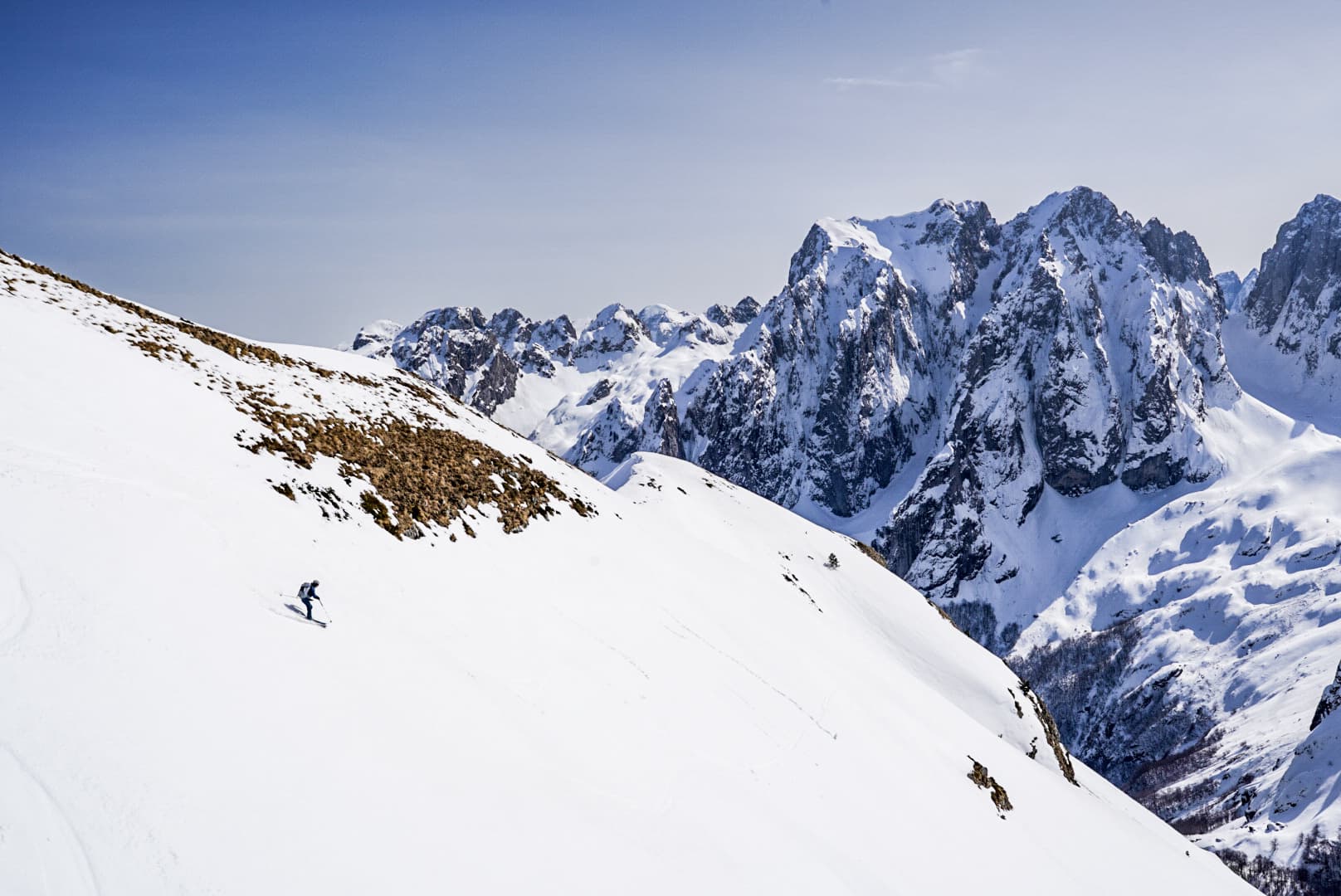
We enter deep gorges, those of the Cijevna, or Cem valley. At the bottom of these are the first two villages of our crossing of the Prokletije: Lëpushë and Vermosh, a stone's throw from the Montenegrin border. In the dark Albanian night, all the clues are good to take to guess the snow limit.
First contacts with the Albanian forest, identified during the preparation as one of the great uncertainties of the itinerary. As the days go by, the Prokletije reveal their contrasts: deep valleys, sometimes impenetrable forests, open valleys, isolated villages and borders that you cross on skis.
Between Albania, Montenegro and Kosovo, this crossing is a line of permanent adaptation, where the route is built as much on the map as on the ground.
Information
Itinerary
From Vermosh to the Čakor pass, a ski line between Albania, Montenegro and Kosovo, through forests, passes, villages and large valleys.
Interactive map — zoom deliberately limited.
First entry on skis into the Prokletije, between wooded ridges and slopes of Maja e Grebenit.
18.3 kmD+ 1010 mD− 760 m
Passage through the Maja e Vajushë, then search for a route through the Albanian forests to the village of Škala.
14.8 kmD+ 1120 mD− 1260 m
Passes, couloirs and forests before moving towards Vusanje and returning to Montenegro.
29.0 kmD+ 1240 mD− 1330 m
Crossing towards Albania via Maja e Rosit, at 2,522 m, then long descent towards Valbonë.
25.9 kmD+ 1750 mD− 1700 m
Between open valleys, forest tracks and remote villages in the Albanian north.
25.6 kmD+ 1650 mD− 1570 m
Long stage on the border ridge to the Gacaferi hut, on the Kosovar side.
28.8 kmD+ 1920 mD− 1230 m
Large valleys and return to Montenegro to the isolated hamlet of Babino Polje.
21.6 kmD+ 1380 mD− 1780 m
Passage through Starac then descent towards the Čakor pass road, end of the crossing.
18.2 kmD+ 1210 mD− 1230 m
The story
We can say that this new journey, following Greece, began in Igoumenitsa. From here, with Aurélien, who continues with me, we had several options. My favourite, more cavalier, is to cross the border via the island of Corfu, taking the ferry to Corfù this evening, then taking a second ferry to Sarenda early the next day. But we don't have the courage, and prefer to keep company with Iris, who takes her ferry back late in the evening.
The other option is to take a bus from Igoumenitsa to Saranda. There is just an option with a bus passing early in the morning to drop us off.
So, from 4:30 a.m., we stand at the point indicated by the bus company. The driver sent me his location live and I don't really understand why he stopped in the centre of Igoumenitsa, a short distance from the point where we are waiting. Without really understanding, I will understand this wait a little later, when we arrive at the Greek-Albanian border.
The barrier is closed. The border is closed at night and only opens at 8am. A closed border. As Europeans, members of the Schengen area and the European Union, this seems strange to us, such control to move from one country to another. But by moving from Greece to Albania, we are effectively leaving the EU. The controls are therefore stricter than here.
We have to get out of the bus and show our passports. Twice rather than once: first time on the Greek side, then a second time on the Albanian side.
I see the timing moving forward. However, I thought I had a considerable margin: departure at 4:30 a.m., more or less 1h30 drive. Best case scenario, we had to be in Saranda around 6am. So I told myself that with 2h30 of margin, I could book a bus at 8:30am to reach Tirana. But as we approach Saranda, I see this margin disappearing visibly. Crossing the border made it disappear like snow in the sun.
Now I'm frantically checking the GPS and I feel like our second connection is going to pass us by. So I go to see the driver to explain my problem to him. For him, there is no problem: he calls the company office to hold our next bus. But this one just left.
Arriving in Saranda, we wait a few minutes, then a solution is found. There is never a problem here. We got in a taxi and joined the bus we were supposed to take, which was waiting for us a few kilometres further. Well, the driver doesn't seem very happy with the situation.
It will take us a little over three hours to reach Tirana and meet up with the rest of the team. I book our third bus of the day for the town of Shkoder, in the very north of Albania. There, Pedro is waiting for us with his big Mercedes bus, and it is with him that we will finish this long crossing of Albania.
We enter deep gorges, those of the Cijevna, or Cem valley. At the bottom of these are the first two villages of our crossing of the Prokletije: Lepushë and Vermosh, at the very bottom of the valley, a stone's throw from the Montenegrin border.
When we pass Lepushë, in the dark Albanian night, I try to perceive the snow limit. All the clues are good to take, especially the remains of snow removal on the side of the road. The higher we go, the more this snow is present. It seems to me that we will be able to ski to the village. This is good news: the snow limit is much lower than in Greece.
Tonight we sleep in Vermosh. Mother and daughter welcome us to a guest house that, at home, we could describe as an agriturismo. Here, there are chickens outside and sheep in the stable. And the meat we are eating tonight was probably produced here, by them.
This morning, it's the young girl who takes care of our breakfast. She is also the one who speaks French. She serves us a kind of fried pancake, with a little taste of come back. When we ask her her age, we are all surprised: she is only 14 years old and already has a maturity that leaves you speechless. Her English is very good, with an American accent which suggests that she learned it while watching series.
Vermosh does not have a town centre. The houses are scattered across a valley floor, now completely cleared of snow. This morning, we will have to walk a little before we can put on our skis. Fortunately, the presence of a forest track will allow us to wear shoes lower than the actual continuous snow limit.
I was worried that the forests would be too dense to ski. This is partly the case, and some forests are skiable, but it is very difficult to assess their density just by observing aerial images.
We go up a ridge, but I realise that the summit it allows us to reach will not offer us an obvious descent. Indeed, the opposite slope is covered with a forest whose density I fear.
So we set off for a long crossing to the west. Thus, we reach the slopes of Maja e Grebenit (1841 m), from where the descent seems much more obvious.
It stretches along a bare ridge, but where the forest tries to colonize on both sides. The snow, just flaked, is excellent.
Surprisingly, Aurélien is no longer on my skis. Seconds pass, and soon Damien arrives. Aurélien had a good time but apparently everything was fine because he was smiling. But Aurélien always has a smile, and the news that I dread all the time arrives with him: he has strained his calf...
I have already had the case among my clients, and the client had to be evacuated by helicopter, despite all her desire to continue on skis. I fear the worst for the future. Aurel still keeps smiling, and he manages to ski. A ski punctuated with “I’m stupid!” ".
Against all odds, we ski to the gate of the Guest House.
Paolo welcomes us. A big guy who must be in his late thirties, with short-cut hair. He helped me organise this trip, especially managing the taxi. His Guest House seems very recent, and yet he has been running it with his wife for around fifteen years. He lives in Shkodër, and spends the summer here, or comes whenever there are reservations. Organizer's privilege, I have a single room!
Soon it seems like music is coming from everywhere. Speakers outside, emitting RNB sounds modified with a contemporary twist, a treat. And inside, the same sound from the computer, with the image, gendered clips, which highlight the bodies of women, often naked and which convey all the well-felt clichés linked to patriarchy
The meal he offers us is excellent, largely inspired by Greek cuisine. Special mention to the baked eggplants.
This morning the news is not good. Aurélien throws in the towel, at least for today. His calf is sore and he doesn't plan to be able to ski. It saddens me to see him like this, resigned to the idea of not being able to ski. I have to organise his transfer to Škala, our stop for this evening, as well as his reception there.
Paolo will bring him in the morning.
We take the path to Maja e Vajushë, a summit which seems classic on skis in view of the numerous traces of ascent, and especially of descent. Mostly hesitant tracks, testifying to bad snow or unsafe skiing.
From the top, the view is fantastic. We are in the heart of this impressive massif that is the Prokletije. Before us stands an imposing limestone wall. I'm trying to find possible passages for the next day's route, which for the moment I have mostly traced in the foothills of the massif, which seem to have relatively little snow from here.
The southern slope, steep and continuous, looks delicious. Change of plan, we will take advantage of it and we will advise of a possible extension of the day at its base. From here, I don't see anything very obvious, but we'll see.
At the bottom of the slope, we reach a small plateau. The surrounding slopes crush us. One of the options imagined does not inspire me, a collector of wet snow avalanches, which will probably not wait until the next day to receive new snowfalls.
There remains the slope opposite, where the steep jumps seem to be able to be crossed on skis.
Reading the map, I have the impression that we could go up a few hundred metres and go back down due north, in order to optimize the snow limit. But after 200m of elevation gain, we arrive at a ridge, topped by an imposing monolith. On the other side, a steep slope of which we can't even see the bottom, and which gives us all, in turn, a few chills! We turn back for the start of the descent, but I still want to try to cut to the right before reaching the plateau, to take advantage of better snow cover. The skiability of this passage is highly improbable, but I like these uncertainties, and at worst, we will put the skins back on!
I attempt a clear crossing, but it seems too exposed for the group. I turn back and try just below. There's nothing obvious on the map, but I have the feeling that it might work. I cross a small, awkward forest and find myself in a couloir, still above a rocky ridge. On the left, it is even higher. Last chance by crossing on the right. The passage is a bit daring, but we have a rope and there is only 2 m of dry skiing. This will allow me to test the group, some of which I don't know. And in any case, I don't really want to go back up.
At the bottom of the scree, the beech forest is so dense that we are forced to take off our shoes. First contacts with the Albanian forest, which I had immediately identified as a critical and uncertain point when I designed the route.
We arrive on skis at the small village of Škala, where we meet Aurélien. He made his mark in a sort of small two-sided cabin, the roof of which also constitutes the wall. He looks a little disappointed, and we can't hide from him that it was a beautiful day up there. If we hadn't told him, he would have felt it.
A woman and a man, older than her, come to welcome us. Neither of them speaks English, and we communicate with our hands. Dinner is ordered for 18:30, that's the main thing. We are starving. In the meantime, the fridge is full of beers…
The team laughs. She laughed because after running the shower for a long time, inspecting the water heater and testing the sink faucet, I decided that there was no hot water. I had tested everything, except reversing the direction of the tap. The water instantly became hot!
To have our dinner, we enter another small chalet, below. We were thinking of visiting our hosts, but they live in Plav, the slightly larger town half an hour away.
The table is filled with dishes, including a certain number for which we are already accustomed, such as tomato and cucumber salad, and meat. But there is also a kind of spinach and meat pie. A local specialty, a priori, because we will find it on the Albanian side of the massif two days later, in a vegetarian version.
We managed to negotiate breakfast at 6:30am. But as always, our hosts are amazed by these morning hours, which they are not used to with their usual tourists.
There is a lot of humanity in the old man's slightly laughing look. We can't really communicate with words, but looks are enough. They say a lot about mutual respect.
I had the choice between a forest track probably cleared of snow at the bottom but without uncertainty and a “rainbow” climb, as Anne-Laure likes to describe these colored slopes on the slope map, but where the snow starts from the village.
Obviously, we opt for the latter option. Once again, the forest becomes too dense. We have to take off our shoes, push the branches to the side, as best we can. The scree area that we reach is dominated by a rocky projection. On my map, a path seemed to cross it. Checking glance: the path is actually further to the right. Anyway, let's see above.
We didn't need less snow to get through the passage, and even with crampons, it's limited. I put down the piece of rope so that my companions can help themselves. I didn't think that the three dogs who have been following us since this morning would be able to cross it. No difficulty for quadrupeds! We soon leave the forest, and I am not unhappy to no longer calibrate my conversations to the presence of trees, but finally to be able to walk the slope from side to side without constraint.
Looking at the map, once again, I have the impression that we will be able to “cross the rainbow” and climb Karanfili i Ljuljaševića (2224 m) by crossing. This was without taking into account the wall that stands in front of us, where I have great difficulty identifying the points of weakness that the map seems to indicate. My plan B is to follow the summer trail, which is often a safe bet, and do the ascent back and forth. Again, this summit seemed very accessible from the pass, but a steep snow slope dominated by an imposing cornice stands before us. This ledge scares me too much, and I prefer to avoid going under it. Only one dog follows us to the top, the most reckless, who is also the one who begs the least for food. We climb the peaks to appreciate the view, and we are spoiled!
From the pass, a large couloir, wide and steep, allows you to switch to Vusanje. It seems to me that he passes all the way down, without having absolute certainty. The snow is already well transformed, we are there a little late. I am vigilant for the slightest sound of pouring, and take great care to find regrouping points that are as protected as possible. Suddenly, I see with my own eyes what I don't like to see: a piece of cornice, fortunately not very big, breaks away from the crest. He won't come to us.
I am rather relieved to reach the wooded area, even if it is dense and awkward. The trail shown on the map is not, but we are starting to get used to it. Several successive circular craters in the heart of the forest challenge us. First, we think of a natural phenomenon. The Prokletije massif is largely limestone and sinkholes are not rare. But their very regular shape and their arrangement, almost in series, quickly make us doubt.
These holes could well be the remains of a much more recent episode in the history of the Balkans.
In the spring of 1999, during the Kosovo War, these Prokletije mountains saw thousands of Kosovar civilians fleeing the fighting. Entire families crossed these reliefs on foot to reach Albania. Many walked at night, guided by valley dwellers, crossing passes over 2,000 metres in the late winter snow. At the same time, the Yugoslav army attempted to control these passages, and some positions in these mountains were bombed.
The valley which accommodates the village of Vusanje is open and less austere than Škala. A little lower in altitude, spring has taken hold there for a long time. A beautiful trout river flows there. It also feels good to find this less austere, and sometimes heavy, atmosphere of the steep slopes of the Prokletije. The small chapel and the cemetery, a vast field with a few scattered graves, make me doubt the dominant religion here. Looking closely at the bell tower, a partially erased crescent is painted there. This is confirmed by our evening hosts. In the village, the inhabitants are predominantly Sunni.
When I arrive in front of the Guest House, there is no sign of life. I then see an old lady stick her head out of the half-open door of a small shed, then, when she sees me, turn back, as if trying to hide. Odd. I knock on the door, and someone actually comes to open it. A tall guy in his forties, close-cropped hair, not very verbose, perhaps because of his poor English. His father is more talkative, and speaks English quite well for his generation. And beyond that, we find in him the same humanity as in our previous hosts.
The meal is served on the table, placed between the kitchen and the TV area. A rolling news channel broadcasts terrible images of the war in the Middle East. The materiality of the conflict appears to us in the face, with the help of these animated images of incredible violence.
They were surprised by our response, when he asked us the time for breakfast and we told him 6am. They are not used to getting up so early, a priori. Since the day before, there has been this pot of spread lying around on the work surface, and which the patriarch wanted us to taste in all its sauces last night. He filled a big bowl with it this morning, and we had a blast!
I love mornings before dawn. Everything happens at that moment, when the calm of the night provides acute clairvoyance. I go down to the living room, where our host is already busy preparing breakfast. He reads my thoughts and offers me a coffee. She's the one who prepares it for me, on a small blueberry placed on the coffee table, in front of the TV already on at this early hour. I write and I observe. Breakfast is prepared by successive blows, interspersed with long pauses, where sometimes we exchange a few words. He's the one who takes care of it, but she's never far away. These people are touching, in the positive sense of the word.
We leave Vusanje by a motorable road, but soon we have to reconnect with the Montenegrin forest. These beech forests are beautiful, but we like to get out of them... The terrain is still as complex, with micro reliefs not documented on the map. The weather forecast for the day kept changing. She announced a morning slot the day before, then a morning slot when she woke up this morning. It rained last night, and the sky has now darkened. A first rumble, in the distance, calls out to me, and when a loud detonation and a flash of lightning strike just above the slope that we are going up, I understand that a storm is breaking out. At the beginning of March, I didn't expect it! This will be the only warning shot. The sleet that has been falling for a good half hour now has deposited a few centimeters which should brighten up our descents, and fortunately, the sky is breaking and visibility is opening up again. Which is not a bad thing for dealing with this complex terrain.
Now, we go up a vast, not very steep valley, to the Čafa e Furumit pass. Anne-Laure and Aurel prefer to preserve their respective ailments, and we quickly climb to Maja e Rosit (2522m) until Arnaud and Damien join us at the pass. A delicious spring snow adorns this new descent, then comes the time when it is necessary to optimize the snow cover. The slope we are crossing is ravaged by avalanches of wet snow. It is always an uncertain pleasure to evolve in these balls, fortunately a little softened.
It will take us about half an hour's walk to reach Kucaj, a small hamlet where two families live just above Valbonë, an essential place for ski touring in Albania. We are greeted by a young woman who speaks English well, like all the Albanians of this generation that we have met since the start of our journey. Tourism has become the only economic activity in these remote villages. But in Kucaj we are the first of winter, and probably the only ones. The potential of ski touring is enormous here, more so than in the other valleys visited.
Like the two previous nights, we eat in their living room, on the coffee table, served by a mother and her daughter. A feast, again. Especially this kind of broccoli pie. As usual, the huge flat screen, disproportionate to the size of the room, broadcasts clips. This time traditional music.
This morning, when I opened the front door, the fresh smell of tobacco assaulted my still sleeping senses. A man in his fifties, probably the father, is seated on the sofa. He puffs frantically on his industrial cigarette. The TV is still on, but this time it is showing other types of clips, where women's bodies are highlighted.
He was born there, in this house built at the beginning of the 20th century. He draws “1911” in the palm of my hand. Then he shows us the new features: new rooms with double beds and thick mattresses, which contrast with our dormitory and its spring mattresses topped with soft foam, testifying to a real move upmarket in these tourist accommodations, probably correlated with a demand in this direction. Not ours anyway. He seems very happy to see us, a small variation of a daily life that is surely quite lonely in the winter in these remote mountains.
We're going back to basketball. Too tired to continue at this pace, Arnaud prefers to take a break. Changing countries almost every day, on either side of this border ridge, it is not as simple as a star trip would be. I therefore offer him several options, and the chosen one consists of accompanying him to Vusanje, where he will spend the next two nights. He will join us in Babino Polje by taxi to finish the last stage together. Burning is a widespread practice here, and up to high altitudes, fields have been burned, leaving a persistent smell of sulfur. We go up a wide valley to Qafa Prosllopit, allowing us to switch again to the Vusanje valley left the day before. After accompanying Arnaud to the bottom of the snow, I join the other part of the group at the summit of Maja e Fazlis (2194m), where the uncertain path which must lead us to Cerem begins. As is often the case during this crossing, the forest turns out to be the problematic point, especially on the descent. A first area, barely colored on my map, is already steep and barely passes between the jumps. I fear for the next crux, tinged with a slightly darker yellow. Above all, I hesitate between two small parallel valleys. The map does not help me to take one option rather than another, but the aerial image rather convinces me of the option on the left, the one on the right seeming more rocky. After some acrobatics to cross an area of dense vegetation, we find ourselves above an impassable jump. Failure. We turn back, and the other option turns out to be much more convenient. The rocks that appeared in the aerial image were in fact just a vast scree, nothing like the escarpment that I imagined at the time. Not without difficulty, we manage to overcome the uncertainties of the plant cover and join a snow-covered forest track up to the village of Cerem. I just scored a good point for Anne-Laure, who HATES putting skis AND boots on the backpack.
We are greeted in front of a large building with chick-yellow shutters. A “diffuse” guest house where each small building has its function: kitchen on one side, living room in another, dining and sleeping area in the large building. The living room is a small wooden cabin with a slightly sloping floor, heated by a small, extremely efficient wood stove. Above the curtain rod, in the dark paneling of the room, sat a large, improbable portrait. A woman with voluminous hair and eighties-style makeup looked at us with a frozen smile. Draped in a shiny purple fabric, it looked like it had stepped out of an old glamor magazine. There was something deliciously incongruous about his presence. The meal is gargantuan: a dozen guests could sit there without anyone lacking anything, an indication among others of this generosity in the welcome. After dinner, we return to the small living room for our now traditional digestive belote tournament. Our hosts sit with us around the small coffee table, and we exchange looks and the fact of being together, much more than words, rare and translated into gestures and mimes. This warm presence is pleasant. Tomorrow will be the longest day. About thirty kilometres and not far from 2000m from ascent.
I love these days when the relief develops for a long time under our feet. These days where we cross passes and ridges, where the terrain changes as we progress. These days when you have to be cunning to cover as much of the distance as possible on the descent. These days that start early and end late, and where the aperitif represents a form of accomplishment.
A first climb takes us to the top of B24, not without reminding Damien of one of the music groups that rocked his younger years, and Aurélien of the usefulness of the ski crampons that he did not take with him. A beautiful descent then drops us at the origin of a long wooded ridge, which we will ride for the next few hours between Montenegro and Albania. From the top of “B26”, the view opens onto the vast, gentle valley of Doberdoll, which was once an option for a stopover. I preferred Gacaferi, behind the border ridge, on the Kosovar side, because the hut looked great, and I wanted to mix the three border countries in this crossing of the Prokletije. These prokletijes, so steep in the first part of the journey, now completely changed in relief to offer more rounded summits and this vast, not very steep valley of Doberdoll. An ideal playground for snowmobiles, which reign supreme, offering us the pleasure of noise and smell, and the furious desire to escape! One of them comes to meet us at that moment, his knee resting on the seat of his snowmobile, as if to watch over visitors to the place who might not be as noisy as them. In humid heat we climb the steep southern slope above us, giving access to this new border, materialized as since the beginning of the day by a geographical watershed.
Gacaferi is a small mountain hamlet, where the Kosovar flag flutters in the wind. For the first time since the start of this crossing, we are not the only skiers: two other groups of young English people are soon joined by the couple we met by chance in Vusanje two days earlier. She is Chinese and lived in Pau for nine years before moving to Trentino-Alto Adige to join him, a young Italian mountain guide who speaks almost not a word of the language of Dante and Petrarch.
We are struck by the quality of the welcome. So certainly, there is not the charm of the “homestay” welcome that we experienced the previous evenings in all the villages we passed through, but here, nothing is left to chance in the attention paid to the comfort of the visitor. The bar is self-service, with everyone recording their drinks in a small journal. A lounge area has several comfortable sofas, arranged in circles and facing a large opening onto the mountains, and the dinner, prepared in particular by the mother of Adriatik, the caretaker, is unequivocally the best since the start of our crossing. The buffet is a great test of self-control, and very often ends with the same observation: “well, we're going to sleep on our backs tonight..!” ". There is such diversity and it is so well cooked that it is not easy not to try every dish. Even our dog has never been so fed, and that's probably what will lead him to abandon us.
The Gacaferi hut only has good qualities, except that of forcing us to have breakfast from 8am. Too late for spring conditions, and too late for today's weather forecast, conditions for which are expected to deteriorate from midday. Despite everything, I am not changing the ambitions of the day, planning the ascents of Maja e Ropes (2502m) and Maja e Qenit (2405m). As we plunge the beautiful ridge of the first summit, grey cumulus clouds form at an impressive speed. We switch to the eastern slope for a beautiful descent which takes us away from our cape, but a forest track allows us to go around the mountain at a lower cost to reach a small alpine hamlet where many constructions are recent, testifying to a marked interest in these mountain spaces. At the entrance to the village, an old Renault R5 has been modified to equip it with caterpillars. The weather seems to be hesitant, between clouds and clearings, sleet and dry weather. From the summit the long valley of Babino Polje unfolds under our skis. A hamlet that Michel Parmentier evokes in his story. The descent is delicious, transformed into snow. On the other hand, a continuous belt of fir trees blocks access to the bottom of the valley. These are not spruce trees with high branches, but perfect cones whose lower branches touch the ground, and very often those of their neighbours. It is a precision ski that must be deployed and cunning to find the way through this labyrinth. Fortunately, the belt is not wide, and we reach the bottom of the valley and its track, groomed in its centre by the successive passages of Lada, whose lower body touches as the ruts of the wheels deepen.
We find Arnaud, who came to meet us on this track. The hamlet of Babino Polje has 4 or 5 houses, on the other side of the river, and around fifteen others are built along the track, including our guest house. A complex that appears massive to us, made up of several small two-storey houses attached to each other, and a building of 4 or 5 floors, immense, disproportionate compared to the other buildings in the valley. It reminds me of Asian buildings, with its three successive hipped roofs, intersecting the top three floors. Its construction is not completed, it even seems far from being finished. Surprisingly, part of the roof is missing on its front part, further reinforcing this feeling of incompleteness. We are greeted by a young couple. She is fully pregnant with their fourth child.
Unlike other accommodations, where it is often elderly or very young people who take care of us, here the pace seems much more sustained. They don't seem bored. Three children, and soon four, a huge construction site that the husband is leading alone, and a guest house to manage all year round: all this leaves little respite. Besides, we feel they are a little overwhelmed. Everything here seems to be done in haste, and that raises questions for me.
In our small dormitory, the shower was dismantled. The husband tries to bring it back up for us, but in the end, there will only be hot water — too hot. So we will go and shower in the shared shower. And here again, you shouldn't be too fussy about the construction details: the tiling is not very well laid, the shower, with rain option, does not work, there is no moisture evacuation system...
In the room that serves as a refectory, an umbrella-type gas heater attempts to warm the space, without much success. Here again, the ground is sloping — and what a slope.
All these little elements give us the feeling of a life led at a frantic pace. Perhaps by connecting certain details, a form of coherence appears: the big Q7, old generation, parked in the courtyard, the Moncler polo shirt, the latest generation Samsung Ultra, and then this disproportionate construction.
All this seems to converge towards the same horizon: a quest for greatness, undoubtedly abundance or wealth. But sometimes, perhaps, it is better to keep another measure, otherwise we risk falling into approximate excess.
Even so, we are well received, very well indeed. After showering we are invited to have tea or coffee in the small space which also serves as a kitchen and bedroom for the whole family. This is the ground floor of one of the small houses.
The front door rubs against the linoleum. You have to lift it slightly to open it. There, we enter a room which, on one side, is equipped for cooking, and on the other where sofas will be transformed, in the evening, into a large bed for the whole family.
At the back, a small glass veranda accommodates a table and two benches. It is in this small space that we will spend the afternoon playing cards, pleasantly warmed by the wood stove and by a small circular oven placed on the floor, in which our host bakes his rolls.
I leave the group to go do a little scouting. Tomorrow, we will not have time to test: we will have to go for the most efficient one, because the day is timed. A few hours of skiing in the morning, then, around 1 or 14:00 at the latest, the taxi must come and pick us up to take us back to Durrës, from where we board the ferry that same evening.
Several options are possible. I chose the simplest, the least uncertain - perhaps not the most beautiful or obvious line - but the one which I am sure will not deliver any surprises. Especially since the weather forecast for the next day is uncertain, and it will probably be the least beautiful day since the start of the crossing.
When it is 6 a.m., we enter the family's living space again. The sofas have been deployed and everyone is sleeping on this large sleeping surface. Everyone, except the mother, who kindly agreed to serve us breakfast immediately. She even prepared pancakes for us that were still steaming, placed on the plate in the middle of the table.
Before leaving, we are given what will prove to be a precious sesame: the paper which authorizes us to enter Montenegro from Albania without going through one of the official border posts. At my request, the husband went to pick him up for us last night in Plav.
To climb to the top of Starac, I therefore had two options. One was to go east and go through an area of dense forest that looked very steep to me on the map. The other, going around to the west, was to go up gentle slopes to Javorsko Brdo, then follow a broad shoulder to the summit. It’s this simpler option that I liked.
From the summit, we switch to the north slope to ski a delicious little layer of powder on a hard base. Then we cross straight towards the west, trying to avoid heavily wooded areas as much as possible. In this game, snowmobile tracks prove to be valuable clues, allowing me to connect the open spaces also spotted on my satellite images.
We put the skins on one last time to climb to the top of Djevojački krš. From here, we have a magnificent view of the entire wide valley which borders the Prokletije. In the middle of it, there is the magnificent Plav Lake. And at the very bottom, our starting point eight days ago, a little hidden by the numerous clouds which are gradually piling up on the summits.
We begin to descend a wide ridge of spring snow and, quickly, I realise that this is not the one I wanted to follow. The other is hidden by the fog which gradually invades all the peaks. So we turn off and enter another fir forest. But in this one, the trees are relatively spaced out and skiing is rather easy.
Damien has just had a great flight. He had not seen a small break in the slope caused by the effect of the wind. He dislocated his shoulder. He recovers instantly. Damien looks really bad: he hardly expresses anything, but I feel that he is in pain.
I slow down the pace to finish this not so easy section to ski. At the bottom of the forest, we join a track, then, from the track, the road to the Čakor pass, starting point for Michel and Périllat during their big ski traverses of the 80s. Original inspiration for this travel project. I think about it and it doesn't leave me indifferent.
Now we go down to the sides of this road, partly cleared of snow. Soon, after a turn, it seems to me that a car is parked in the middle of the road. Strange for a road that seems passable. And as I get closer, I understand.
On it it says “policija”. On the two front seats, two police officers seem to be waiting for us. When they see us, the passenger in the car gets out, and I know very well what he is going to ask me. Even before he does, I take out my passport and ask my companions to do the same.
And then I also hand him this precious sesame, which I am happy to have had the foresight to ask for - helped a little by the discussion I had with our host from Skala on the third evening. Without him, I might not have thought about it, because last year we went from Albania to Macedonia, then from Macedonia to Kosovo, without going through the official border posts, and yet we left via Pristina even though we had arrived via Tirana.
The two police officers took our passports into the car and, after a few minutes, they returned them to us. A priori, we pass this check without incident.
I ask them for confirmation – not without difficulty and thanks to Google Translate – that the taxi will be able to pick us up at the end of the plowed road. I don't quite understand the response, but it seems to me that it is rather positive, whereas they were quite austere when they approached us.
They relaxed when they saw that we were in order and even smiled when I made a mistake in the Google Translate buttons and made them repeat their answer.
As we wait for the taxi, a large pick-up pulling a trailer on which a buggy is placed stops alongside us. Inside, two men in military fatigues, rather smiling. They present themselves as border guards. They are already aware of our presence here and ask us if this is where we are waiting for the taxi.
It is precisely half past twelve when we arrive, exactly the time I had sent this morning to our taxi driver.
The taxi driver doesn't speak a word of English. He only asks me: “Where are you from?” » I explain to him that we have to stop on the way, at Lepushë, to collect all our luggage. I try to write this to him on Google Translate, but, unsure whether he has understood my request correctly, he calls a friend — a local guide from ski touring living in Plav, who speaks perfect English.
So I explain to our improvised interpreter that we simply have to stop at Lepushë to collect our things.
Our driver has an annoying tendency to look at his phone and, at one point, it couldn't be missed. He doesn't see the car stopped in front of us. Fortunately I make a movement with my hand to grab the steering wheel and jerk to the right so that he finally reacts. It was time.
When he arrives at the port, he seems completely lost. I send him a Google Maps link and, apparently, this is the first time he has used this application. Moreover, when he finally manages to drop us off more or less at the desired location, he asks me to send him a link to leave the port and return home. He obviously didn't know how to use Google Maps. For a taxi driver, this is still a shame.
The taxi will take us to the ferry in Durrës, where we will have just time to buy something to eat before boarding. The ferry will disembark us in Bari, in the south of Italy, and we will barely have time, after going through customs, to take a bus to the central station. Here again, we will just have time to buy something to eat before boarding the train which will take us to Milan.
In Milan, we will just have time to change platforms to take a last train from the Trenord company which will take us to Novara. This is where there might be the one little grain of sand. Indeed, when leaving for the ferry, I wanted to move my car so as not to leave it in the same place for two weeks. It made a weird noise, then it stalled. She told me: "It's probably the battery", but I still had my doubts, since the car had started before stopping.
Portfolio
A traverse of the Prokletije
LES GRANDS RAIDS À SKI