D1
Imlil → Tacchdirt
From Imlil (1,740 m), passage of Tizi n'Tamatert (2,279 m) then descent towards Tacchdirt (2,300 m).
13.3 kmD+ 1180 mD− 550 m
Trip journal
A ski journey in the High Atlas
January 2026·5 days·82.1 km·D+ 7830 m·D− 7210 m
We are rattling around in an old Peugeot 405. Four hundred and twenty thousand kilometres on the clock. At each hill, the underbody scrapes the track soaked by the rain that fell all night. Above us, vast sections of mountains and an unstable slope. Mohammed sings, his gloved hands grip the steering wheel. Mohammed prays.
Skiing here is not easy. Snow is rare, but when it does start to fall, it can be capricious, requiring constant recomposition of the route. The High Atlas offers us arid valleys, high plateaus swept by gusts of wind and remote valleys where century-old junipers grow.
Information
Itinerary
From Imlil to the Berber valleys, a line reconstructed over the course of the snow, the passes and the constraints of the terrain.
Interactive map — zoom deliberately limited.
From Imlil (1,740 m), passage of Tizi n'Tamatert (2,279 m) then descent towards Tacchdirt (2,300 m).
13.3 kmD+ 1180 mD− 550 m
Talate n'Chaoute, Tizi n'Ou Addi, Tizi n'Itbir then Agounss before the long descent towards Timichchi.
17.5 kmD+ 1460 mD− 1850 m
Ascent via Labassen and Tizi Tacherddirt, ascent of Bou Iguenouane (3,882 m), then return to Tacchdirt.
19.5 kmD+ 2200 mD− 1790 m
The crossing project to Amsouzart is abandoned. Return to Imlil then transfer by taxi to Tizi Oussem.
10.0 kmD+ 640 mD− 690 m
Passage through Azib Tamsoult, the high passes around 3,000 m and Tazaghart (3,980 m), before the descent towards Tizgui.
21.8 kmD+ 2350 mD− 2330 m
The story
This winter, snow fell in abundance in Morocco. The High Atlas Mountains are covered in powder, which attracted Yann Borgnet and his companions. But plan A was transformed, through twists and turns, snowfall and administrative hazards, into improvisation. A superb ski-in/ski-out adventure, among the inhabitants of the lost hamlets of the Berber mountains.
We are rattling around in an old Peugeot 405. Four hundred and twenty thousand kilometres on the clock. At each elevation of the terrain, the underbody scrapes the dirt track, wet from the rain which has been pouring down since the middle of the night. Above us, vast sections of mountains and an embankment destabilized by the earthworks of the road. Mohammed sings, his gloved hands grip the steering wheel. Mohammed prays.
Behind me, Julien is pale. From his half-open foggy window, he watches the falling stones, in a heavy silence. His jacket protects him from the gusts of wind which push the rain inside the passenger compartment.
We come back down from Tizgui, a small Berber village lost to the west of the Toubkal national park. Last stage of a journey where the term adventure took on its full meaning. The adventure, like a game with uncertainties: those of the mountains, of which we are accustomed, and those, more local, of the Moroccan administration... and, suffice to say, the latter disconcerted us.
From the outset, the snow interfered with the plans, making them unrealistic and requiring them to be urgently recomposed. This snow, which nevertheless called us here, pushes me to my limits. Forty centimeters in the streets of Imlil. Rare event. We are lucky.
Since yesterday evening, I’ve changed my mindset. The original plan has become completely obsolete, and the time for planning anything is over. I just want to open up the possibilities, to be able to improvise.
Yesterday, we came from Imlil on skis, after landing the same morning in Marrakech. The mountain roads beyond were cut off by snow. In a hurry, we prepared our bags for six days of skiing, leaving all the excess with Hassan, our driver, who will bring them back to us on the last day.
Imlil. We put on skis in the heart of the city. Residents are busy clearing snow from flat roofs, because water seeps into them when the snow melts. On every corner of the alley, Berbers offer us tea, intrigued by our paraphernalia. There, a small snowy ramp is the place for various slides for the village kids: some on sleds, others on trash bags, others still on skis, sometimes wearing sneakers.
We reach Tizi n’Tamatert, from where the north faces of Likemt and Igounouane appear, imposing and laden with snow. Passing the pass marks a clear change in atmosphere: the fresh wind and powder of the Tacchdirt slope replace the stifling heat and soggy snow of the Imlil slope.
Tacchdirt lights up gently, while the muezzin sings. We reach the village at dusk. Ibrahim welcomes us with all the gratitude I know, forged during our numerous telephone exchanges.
Indecision. The Likemt option, starting point for a possible crossing of the Toubkal on skis, comes to mind, but it is very risky. There are too many uncertainties about snowpack conditions. Our tired minds have little energy left to make a good decision, which is in fact postponed until tomorrow.
In the early morning, with the strength of the collective helping us, we decide to explore the Ourika valley, east of the Oukaimeden station. The day before, we had spotted skiers going down the Tizi n'Ou Addi, and a long horizontal trace which allowed us to reach the valley from Tacchdirt.
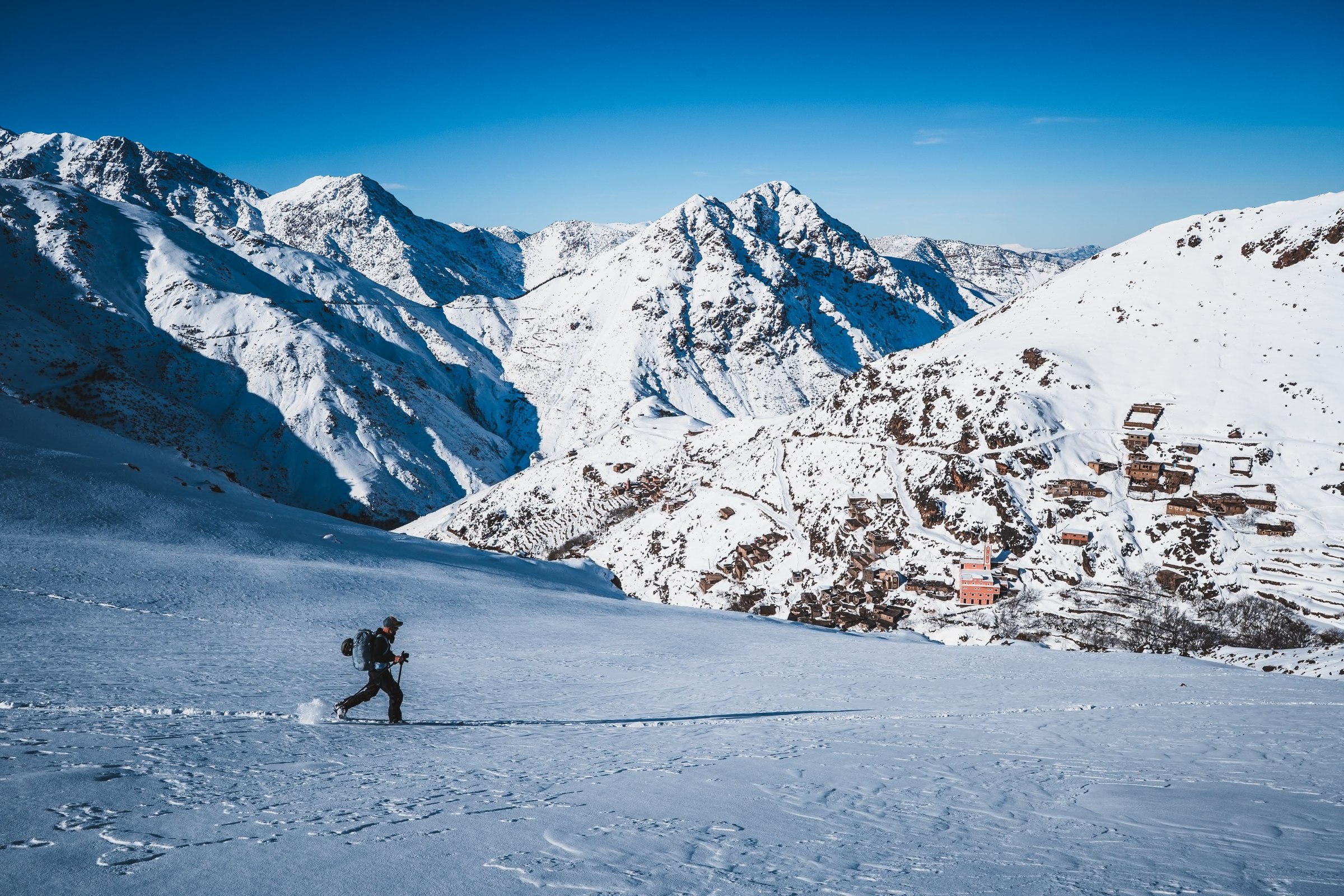
We cross the southern slopes following these footprints. They reach the hanging village of Talate n’Chaoute, and its mosque with its pink minaret, like everywhere here.
At the top of the valley, the Tizi n’Ou Addi gives access to a beautiful powder slope little affected by the wind. The initial plan was to go eat a tagine in Oukaimeden, but the slight slope of the valley quickly discouraged us.
Just above the Tizi n’Itbir, the pass which connects the Oukaimeden plateau and the Ourika valley, we are tempted to reach the small summit to the north. The wind has stopped and, as far as the eye can see, an arid expanse stretches. What a contrast!
The valley, long and regular, is delicious to ski. Soon, we arrive at the first village, Agouns, from where we hear a surprising commotion, improbable in our eyes in such a remote place. Everywhere, the inhabitants are busy with their activities: the women are in the bed of the river, probably doing the laundry, some are tending the herds of cattle, the kids are playing.
Agouns is an agro-pastoral village perched at around 2400 m altitude, the last douar in the upper Ourika valley. Organised in six small neighborhoods above terraces cultivated with barley, corn and some food vegetables (turnips, beans, potatoes), punctuated by rare walnut trees, it is only accessible in summer by a 4×4 track. In winter, you have to take the path on the mountainside to go down to Timichchi, where the asphalt road allows you to reach Sti Fadma, the town, more than ten kilometres downstream.
We enter a beautiful masonry residence. With the traditional welcome tea, Brahim takes the time to tell us about the life of his village. Timichchi, 42 inhabitants, was bereaved by the earthquake of 2023. There were seven victims and many houses destroyed; some were rebuilt on the opposite bank of the river with government help.
These are masonry, pink houses, which contrast with the historic stone constructions. The tagine is served with the muezzin singing. Brahim is getting ready to go and pray, like five times a day. Most of the time, he goes down to the mosque, which was once the social place on cold winter days. Everyone brought their own wood, and a large fire in the middle of the room livened up the conversations. This sociability has disappeared, Brahim points to the joint arrival of electricity and the internet.
The next day, we reach Labassen with the first rays of the sun.
Labassen is a village of around twenty houses, located in a small valley adjacent to the Ourika valley. A mountain village, without road access, cut off from the world as soon as the snow falls. The flat roofs of the houses become terraces occupied by the inhabitants, who settle there to enjoy the sun. Here, the houses are not heated.
Since the opening of a covered terrace, children have had fun greeting us. Women are there too, perhaps intrigued by our presence. Skiers must be rare here.
We reach a vast valley with thousand-year-old junipers. The faces above us are steep, striped by numerous ice waterfalls. Yesterday, looking at the map, it seemed possible to reach the summit of Bou Iguenouane by following the emerging ridge of Tizi Tacherddirt. Against all expectations, we reached the ridge quite easily, then, via an incursion on the south slope, the summit, in the wind and fog. Too bad, I really wanted to see Ouarzazate, and the desert. Where, when I was seven or eight years old, my father took me in 504 across the Sahara.
Tacchdirt. During the evening meeting, we decide to attempt crossing the massif towards its southern slope, being well aware that we will most likely have to exit via the south and the town of Amsouzart, because there is little chance that the weather on Saturday will leave us with the possibility of returning to Imlil on skis. Yallah!
That evening, there were people at the lodge and, in retrospect, everyone seemed to play a very particular role. First the snowblowers, finally arriving in Tacchdirt to open up the village. Then three Flemish Belgians, who came to ride, guided by Ibrahim’s brother. Two retired Pyrenees, opportunists like us, ski without a guide from the lodge.
And Mohammed, brother of Ibrahim, local guide, wearing a little purple cap, with a crooked smile. Friendly, but somewhat suspicious: he threatens to call the police because our planned crossing would violate the rules. But joking, we think. From this ludicrous scene, I understand that the host is responsible for the tourists he welcomes, and that our bivouac project at the Azib Likemt does not please him. Our discussions stop there. We are determined to maintain our project, the weather and snow conditions being favourable.
We leave Ibrahim and his lodge to reach the road, perfectly cleared of snow. A young man in a traditional scarf leans against his scooter. I'm about to take out my camera, then I change my mind. He walks towards us and asks us… for our passports.
Mohammed was therefore serious. He undoubtedly left us ready, having left the lodge shortly before us, accompanying the two other French people, without a guide. That morning, our relationship with Ibrahim was strange. Something had changed compared to the closeness we had known to him until then. He didn't come to greet us when we left, even though we weren't supposed to see each other again. This surprised me. Perhaps he knew full well that it wasn't really a departure.
“You are strictly prohibited from going to the mountains… without a local guide. » This is the refrain uttered to me on the phone by the tourist security manager. There is no possibility of discussion; “informal” arrangements are no longer appropriate. The game is lost.
I am divided on this event, which we are not accustomed to in our mountains. It took us by surprise, sending us the echo of arbitrary decisions, taken in a strong emotional context. Here the very recent deadly avalanche and the traumatic memory of the sordid assassination of two Scandinavian tourists at Azib Likemt in 2018. Indeed, we arrived in the Atlas the day after a tragedy linked to heavy snowfall: three Moroccan hikers, including a local guide, were swept away in an avalanche. The Moroccan administration, and particularly the “tourist police”, is tense: the “disappeared from Toubkal” have made the rounds in the Western media.
I then wrote to Mohammed, the tourist police assistant, to ask him for the laws that govern our skiing in the Atlas Mountains, but I received no response.
From this episode, we also understand that the local guide takes on an additional “social” role, that of protecting tourists in the face of potential reactions from locals. However, everywhere else, the welcome we received was very warm, including in the most remote and less touristy villages. And these are perhaps the most precious memories we will keep from this adventure.
In the light of the headlights of his Dacia, Hassan drives up the road to the small village of Tizi Oussem. He makes us feel that he doesn't like this road. After the pharaonic construction of a hydroelectric dam, the wide, asphalted road was transformed into an earthen track, with unstable lower sides.
We had been expelled from the mountains of Tacchdirt: persona non grata, tourists whose media profile would be too high if anything happened to us. We needed to find somewhere less controlled, less closely watched. We had arrived in the Atlas the day after a tragedy: three Moroccan hikers, including a local guide, had been swept away in an avalanche. The Moroccan authorities, particularly the ‘tourist police’, were on edge: coverage of the ‘missing hikers of Toubkal’ had spread through the Western media.
Without the heavy snowfall the day before our arrival, Tizi Oussem should have been the starting point for our crossing of Toubkal.
A few phone calls from our driver to friends of friends dropped us off at the entrance to a gîte, in the dark. The paint is peeling off the ceilings and scattering the mattresses like confetti. We are invited to follow our guests into the hammam. The young man measures the hot and cold water into a large bucket, and a smaller bucket is used to sprinkle himself. The ground is hot, and the smell of fuel oil tells us how it is heated. When the older of the two Berbers begins to vigorously rub my upper body, I understand that showering here is a collective rite...
On the programme, the Tazaghart, 2,200 m higher. Here, there are no obstacles, a priori. Insha’Allah.
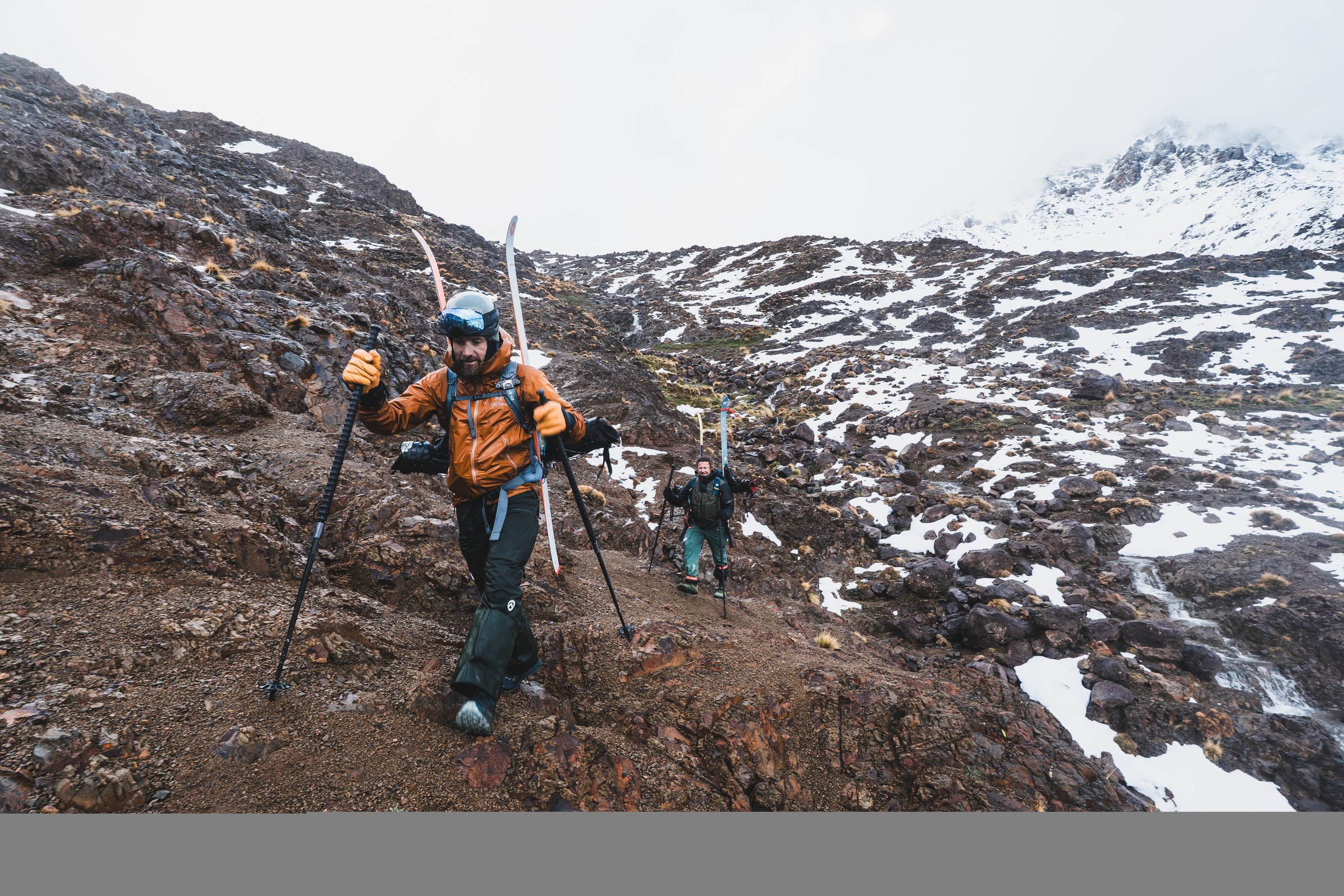
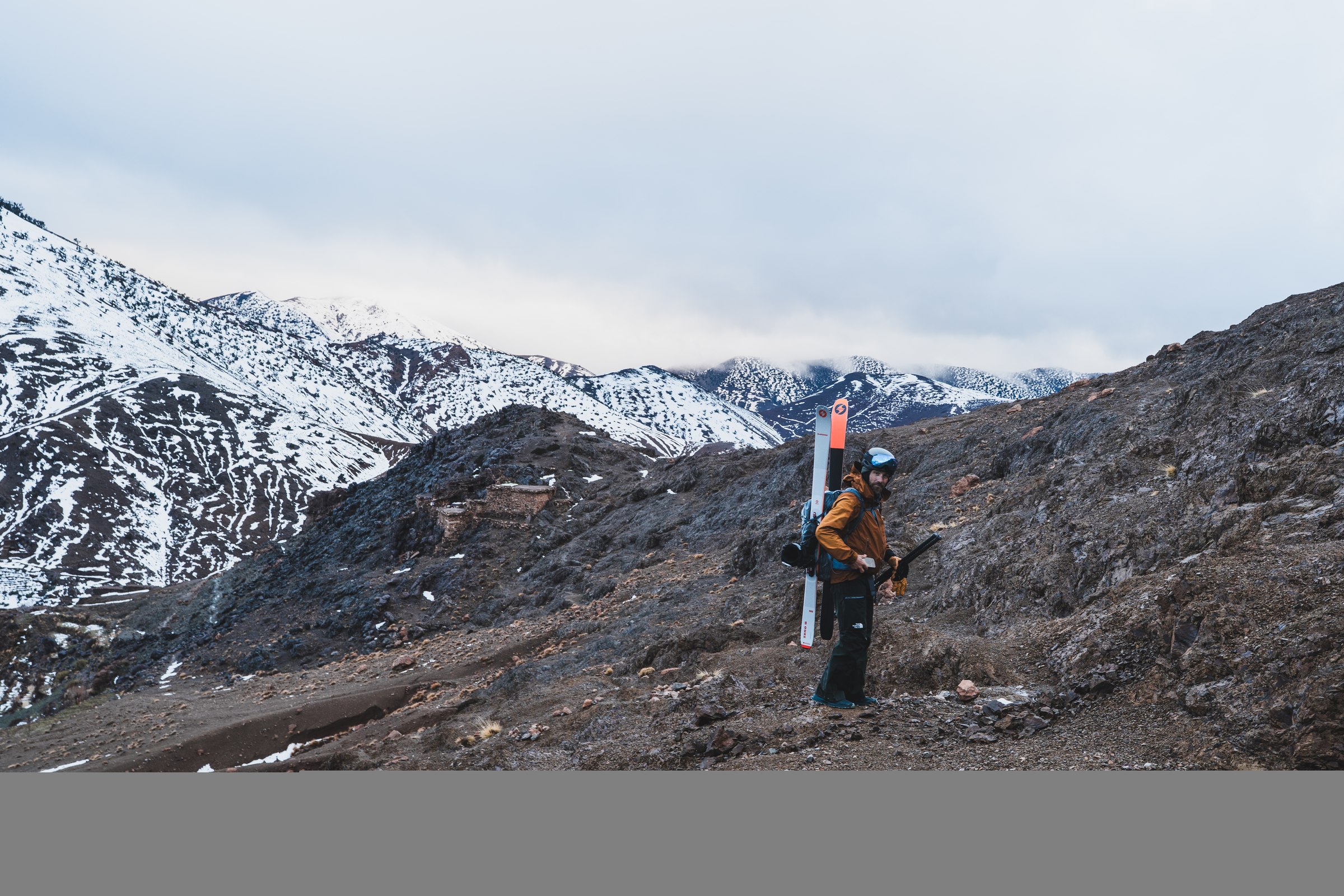
The path first goes up a mountainside amid imposing juniper trees, before arriving at Azib Tamsoult and its namesake hut. Then, two bottlenecks appear in purple on my slope maps, and constitute uncertain passages. The first is exposed, but passable on skis. The second leaves me doubtful: an ice waterfall blocks the passage. I'm hesitant because there may be other alternatives. The wind has picked up and it is already late: I know that this decision will not count on a second chance. It seems that the right edge of the waterfall is thin, passable with the help of the rock. Bingo!
From Tizi Malooan, there did not seem to be any difficulty on my map, but a rocky ledge blocks our access to the summit. A small hidden couloir is hidden behind a tower. Without certainty, I commit to it. Once again, a rocky ledge blocks our access. I cross it not without difficulty, and I help my companions with the help of my stick. We soon stand at the summit, jostled by violent gusts and caught in thick fog.
I am used to wind and fog, but less familiar with this Moroccan frost, freezing rain which lacerates our faces and covers us with a thin sheet of opaque ice. The summit gives access to the vast Tazaghart plateau, swept by the winds and partly bare. Cockscombs are real traps, like fog, confusing us without us being aware of it.
Check my phone: I got pulled too far to the left, to the west end of the plateau. We have to go up against the squalls to find the right direction, to accept that we can no longer see anything, to delegate control of our skis to kinesthetics.
Last turns in the Atlas, end of skiing, but not of the adventure.
Tizgui is a small, lively mountain village. The main artery is a muddy track that is particularly busy at the end of the day. The muezzin begins to sing: without looking at the time, we know that it is 19:00 Another good day! Our ice sheets have melted, we are now soaked by the rain which continues to fall.
From the outside, the cottage appears recent. Hussein, our host, must be 70 years old. His look is mischievous and friendly. The language barrier is frustrating: here, no one speaks French. We fill out the traditional register and our passports are photographed, like every evening. The last visitors recorded in this register were in March 2025! Here, tourist pressure is much less than around Imlil.
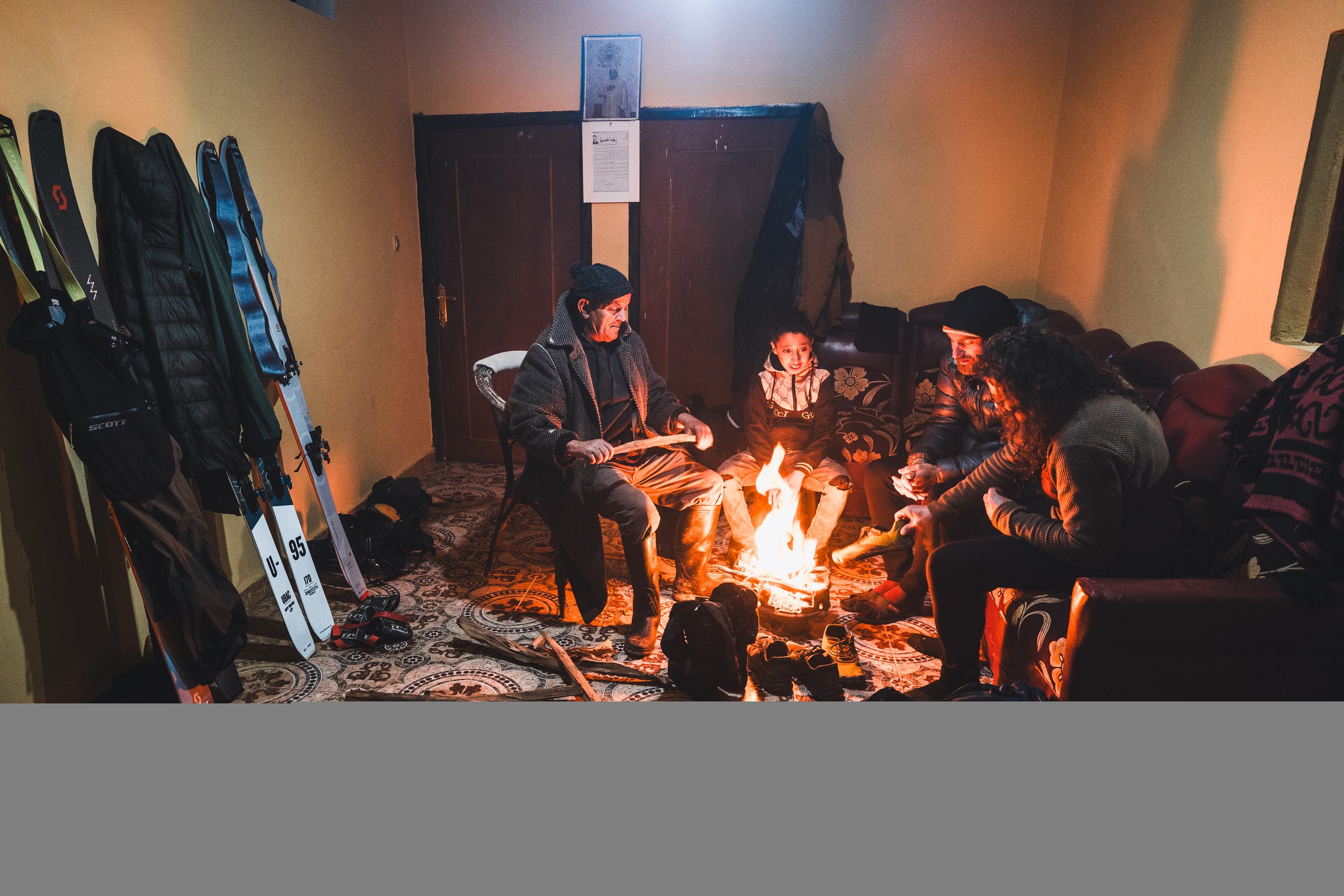
All our belongings are soaked, and we ask if it is possible to have additional heating. While we are enjoying a little “Marquise” (editor’s note: local cigarette) on the roof terrace with Julien, we suddenly smell the pleasant smell of the wood fire. The smell is coming from the stairwell. Strange, there was no fireplace in the lodge. We look at each other, sharing the same question: “Where could they have lit a fire?!”.
The small portable stove sits in the middle of the living room, the fire crackles. Hussein and his grandson, Mohammed, sit around the fireplace, enjoying the warmth. The fumes begin to invade the space, and the means of their evacuation remain enigmatic... The intention was generous and laudable, but our belongings remain too soaked to dry like this. The tagine is delicious, it is undoubtedly the best since our arrival.
After the tangerines and herbal tea, as we get ready to go to sleep, Hussein brings us a dish of couscous. Happy incomprehension. We have no choice but to honor him! Hussein stays there, we exchange looks. He shares tea with us. And this non-verbal presence is, for us, the sign of a warm welcome.
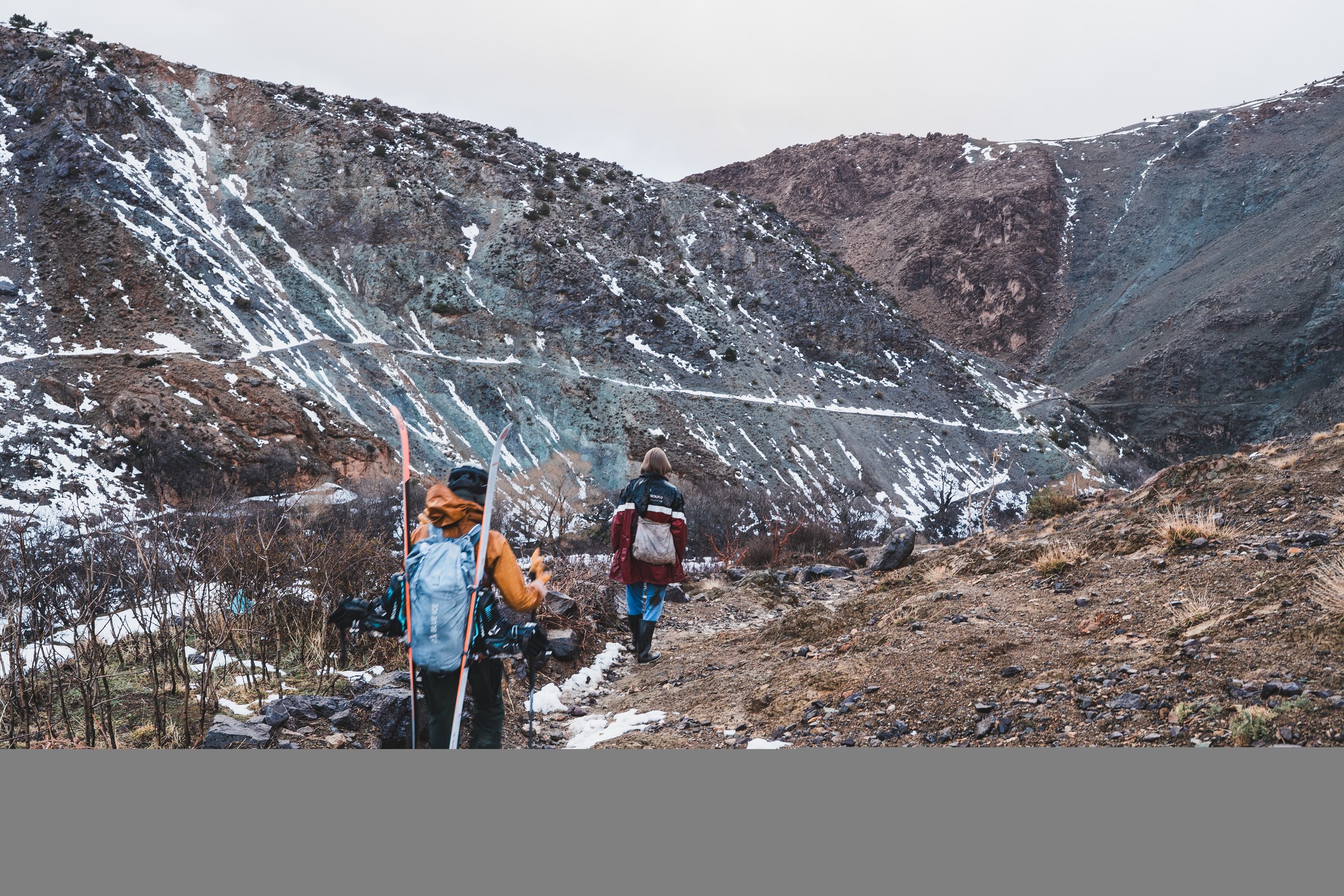
During this trip I learned a lot. This is the first time that everything does not go as planned, that the line deviates, that its path imagined upstream does not come true. If we are always ready to deal with the uncertainties of the mountain, those of the administration, when they are felt to be arbitrary, are always more difficult to accept. Morocco has its rules, and we have to deal with them.
I had heard about the obligation to take a local guide, but according to contradictory statements. I didn’t know that bivouac was “forbidden”. But is it really? What is perhaps more disturbing is the lack of control by local authorities resulting from being “in the wild”, both literally and figuratively.
From this crossing attempt, I have already built my ideal line for the next trip to the Atlas. A line that stops in villages that are not very touristy, because these moments of meeting are among the most memorable experiences of this Moroccan journey. A line that leaves from the southwest of the massif, where there is no tourist pressure, and which deliberately avoids the Toubkal and its hustle and bustle! We can’t wait for it to snow again there so we can return with skis to this contrasting massif.
Portfolio
A ski journey in the High Atlas
LES GRANDS RAIDS À SKI