D1
Oushgouli → Chkhara huts
From Oushgouli, at 2,100 m, climb towards the ridges under the Chkhara then cross to the mountain huts.
11.6 kmD+ 1190 mD− 1020 m
Trip journal
A traverse of Upper Svaneti
April 2024·7 days·112.1 km·D+ 9640 m·D− 10120 m
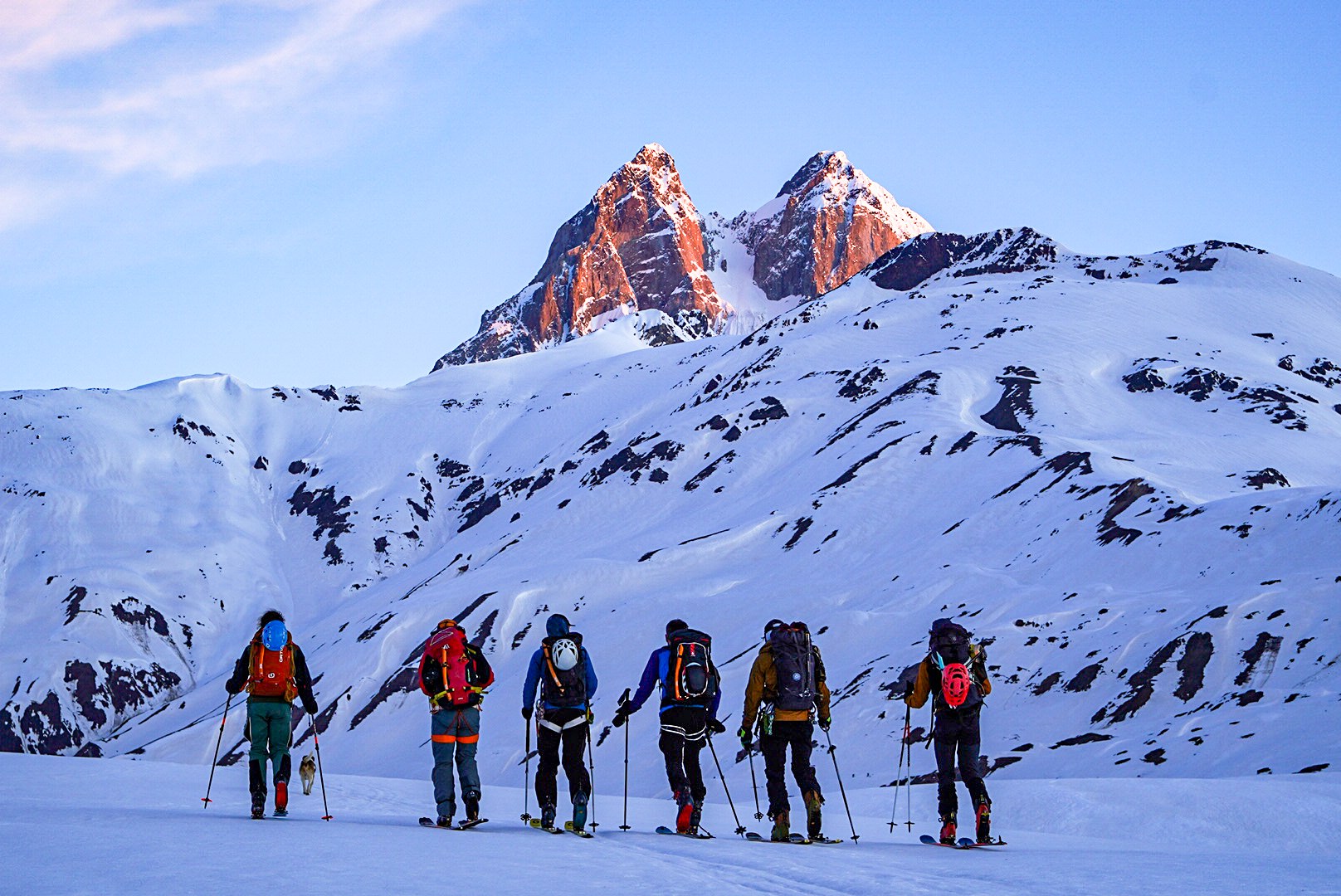
Upper Svaneti is a border territory in the full sense of the word. Geographical border, materialized by the great glacial wall of the Caucasus, but also political and historical. Here, the peaks — Chkhara, Tetnuldi, Ushba — embody a limit. It is in this in-between that this high ski route takes place, from Oushgouli to Iskari.
I have known this region for a decade and this is the first time I have come there on skis. Fresh snow, immense glaciers, serac falls: the mountain quickly imposes its rules. But this journey is also played out in the evening, in cabins and villages, around overcrowded tables, chacha and Svan hospitality. With Shako Margiani, IFMGA guide and native of the country, we don't just cross a massif: we enter a little into its history.
Information
Itinerary
From Oushgouli to Iskari, a continuous line under the great peaks of the Caucasus, between glaciers, passes, villages and alpine huts.
Interactive map — zoom deliberately limited.
From Oushgouli, at 2,100 m, climb towards the ridges under the Chkhara then cross to the mountain huts.
11.6 kmD+ 1190 mD− 1020 m
Glacial passage near the Russian-Georgian border, then descent towards Khalde Mountain Farms.
14.0 kmD+ 1220 mD− 1240 m
Ascent of an unnamed summit around 3,500 m, glacial crossing then descent to Adishi, at 2,100 m.
10.7 kmD+ 680 mD− 850 m
Passage by an unnamed summit around 3,500 m and the Tetnuldi glacier, then descent via Zhabeshi to Mestia, at 1,500 m.
33.0 kmD+ 2180 mD− 2860 m
Climb from Mestia to Cloud Base Hut.
5.6 kmD+ 900 mD− 50 m
Crossing the Chaali pass then long descent under the east face of Ushba to Mazeri, at 1,600 m.
19.6 kmD+ 1670 mD− 2330 m
Last stage via Mount Bok, around 2,900 m, before the descent to Iskari, at 1,400 m.
17.6 kmD+ 1800 mD− 1770 m
The story
Mingrelia-Upper Svaneti is one of the twelve regions of Georgia. It extends from the Black Sea to the high peaks of the Caucasus, which marks the Russian-Georgian border. Several high peaks make up this natural border: Chkhara (5193m) and its nine peaks, the highest point in Georgia and third highest peak in the Caucasus; the Djangha (5059m); the Tetnuldi peak (4858m), which could be compared to Mont Blanc and finally Mount Ouchba and its two imposing peaks (4710m). The Upper Svaneti Haute Route is a ski traverse which crosses from Ouchgouli, at the foot of Chkhara, to Iskari, southwest of Ouchba. This route was carried out by guides Yann Borgnet and Shako Margiani and their 9 clients from 4–10 April 2024. Story.
I have already been to Georgia twice, in Upper Svaneti. The first time, in 2014, when the country was just emerging from a still perceptible escalation of tensions with its Russian neighbour, already engaged in imperial desires. In this six-day blitzkrieg of August 2008, it lost control of two “pro-Russian” and already autonomous regions, South Ossetia and Abkhasia, which became Russian protectorates, after Russia officially recognised their independence in 2008. After two hours of intense “bartasse”, in the middle of the bushes and ferns which obstructed an old path, and with a total amazement, we were picked up by soldiers stationed there to monitor the border, about ten kilometres away as the crow flies. In 2019, the post was still in place, but empty and we had the leisure to return to survey the immense Caucasian glaciers, a stone's throw from the Russian-Georgian border. The context linked to the war in Ukraine is disrupting the destiny of Georgia, which for a time opted for European integration and which is today tossed between two paths. Its president, Salomé Zourabichvili, former French ambassador to Georgia, perfectly French-speaking and pro-European, occupies a mainly symbolic position. The party in power since 2012, “Georgian Dream”, founded by billionaire oligarch Bidzina Ivanishvili, initially claimed to be centre-left and was described as favourable to the market economy and for rapprochement with the West, became openly pro-Russian from 2021-2022. The legislative elections of 26 October 2024, considered “existential” for the future of the country, allowed this party to further strengthen its power, against a backdrop of irregularities and authoritarian excesses.
This context threatened the feasibility of this trip to Georgia: on the website of the Ministry of Foreign Affairs (Ariane), the border is now highlighted with a red border, identifying the “formally discouraged” areas. In other words, a “no go” in the context of organising a commercial trip. I had to deploy (a little) energy to finally receive the approval of the ministry and the embassy.
Tuesday 2 April, we meet (almost) all at Geneva airport. Although I know almost everyone, this is not the case for the participants. Managing a commercial trip also means trying to bring together people who are likely to find points of convergence. For this, nothing better than a journey of more than 24 hours, from Paris/Geneva to Oushgouli, in the depths of Upper Svaneti. The entire group finally meets up in the impressive grounds of Istanbul airport, and this event really marks the beginning of the trip for me, since it strongly influences the rest of the celebrations. After a night of air travel and a stopover, here we are in Tbilisi, where Guladi is already waiting for us to drive us across Georgia, aboard his old Mercedes bus. Belt behind his back, his supple behaviour is strangely not modified by his numerous phone calls, with the phone to his ear. Guladi has his addresses, and the breaks are probably not haphazard. During one of them, we eat our first khachapuri, marking for me the real return to Georgia. We are then at the beginning of the Ingouri valley, the long valley that we must go up to reach Oushgouli from Zugdidi. The Inguri hydraulic dam which stands in the middle of this valley creates a retention basin of several kilometres and contributes 40% to national energy production.
In Mestia, we find Shako, with whom I will work for this crossing. I only know him by reputation, and by the few phone calls we exchanged to prepare for the trip. Shako lives here, with his wife and two children. He is a IFMGA guide, like me, and a very good skier. Winner of the local stage of the Freeride World Tour Qualifier in 2023, he loves skiing and prefers not to concede skiability to the weight of the equipment. This is what surprises me when I hand his pair of skis to the driver posted on the roof of his “Delica”, these small 4x4 trucks which are legion here, essential for our transfer to Oushgouli. We arrive just in time to appreciate the fantastic sunset lights on the numerous towers of the village, at the time used as a protection bunker by each family in the event of attacks and which have become symbols of the region. The imposing wall of Chkhara emerges in fragments and gives us chills with its alpine character.
As soon as dinner has started, Shako offers us a friendly drink. He goes behind the bar counter, takes out a bottle with translucent contents and pours small glasses copiously. According to him, “chacha” is enjoyed during the meal. Here, the dijo starts early! She is “strong” the chacha, and on the eve of departure for 7 days of journeying, no one dares to have more! Except Shako, of course, who happily shares a few extra drinks with the Delica drivers. They don't count the strokes before taking the steep road back to Mestia!
This first day of skiing in Georgia will colour the rest of the journey. It snowed last night, like the previous days, and the wind up there didn't stop blowing. The landscape is immaculate, grandiose. But tricky, too. This morning, it almost feels like we're in an Aravis valley on a Saturday morning, as two large groups of skiers are ahead of us. They stop at the end of the first bump, a great classic of the area. We then continue to walk on a ridge which never sees skiers. As we walk three abreast, not far from the ridge, we feel a whoop followed by a continuous noise. My reflex focuses on the opposite slope but there is no trace of avalanche activity. There was definitely an avalanche, and it started right below us. A 40cm break on part of the face... first alert, I have never triggered such a slab in the Alps, and even less remotely. The fragile layer is sensitive and spreads very easily. A few hundred metres further on, we witness a second alert, much more serious. The scenario is the same. The leading group passes without problem a few cables from the summit ridge, and it is when the second group passes that the entire face leaves, 5m below. At the highest point, the break is around a metre, it's really impressive. I'm going to see what's underneath: the fragile layer is made up of around twenty centimeters of cups...
We reach the two small cabins in which we will sleep this evening. They are still under construction, and the ones we occupy are stored around twenty rolls of glass wool. The table and benches were quickly put together, using metal bed bases and scrap boards. As usual, Etienne stirs and praises the qualities of his new inflatable mattress. Until the fateful moment when, by making him move on the wooden floor, which is certainly new but not perfect, he notices that it is softening... We had a good laugh. Him less. The Chkhara finally emerges with the lights of the setting sun, it is both incredible and frightening. And even more so when, at bedtime, its serac discharges copiously and an avalanche sweeps the entire face. The Caucasus is not the Alps, that is the main lesson from this first day of skiing.
The weather window changes all the time. The snow will fall in the afternoon and we get up accordingly. Soon a ray of sunshine and a few stolen photos with the Russian-Georgian border ridge in the background. With lightning speed, a cloud front invades the sky from the west. However, and as the forecasts indicated, the ceiling remains around 4000m, leaving us with the prospect of a descent via the glacier. Little slope, but a great atmosphere. The snow, excellent at the top, quickly becomes crusty. Here, the temperature gradients are significant, as evidenced by the numerous crawls. We return to our two small shepherd huts, the “Khalde mountain farms”. One is equipped with an old wood stove and three box springs revered by Pascal, Quentin and Shako who have skipped the mattresses. The other is empty, and its old parquet floor accommodates our inflatable mattresses.
The night was cool. The snow has immaculately covered the slopes above us, covering areas left bare by previous avalanches. The border chain, this high wall, continues to crush us with its magnitude. From the unnamed summit that we reach, the view is striking, particularly of Tetnuldi, a peak that I had climbed when I first came to Georgia, 10 years ago. I don't know if I leave much choice to Shako, but I start the descent first, in cinematic snow. It's fluid and the small hard bottom allows you to push the turns. A delight. We all long for this descent, exclaiming with cries of joy, except perhaps Robin who throws a little too hard, jumps and lands head-to-toe. One of his skis is lost, after breaking the leash. From below, I see him coming at full speed, jumping a bump and crashing into the snow at my level. It was less a… Here, the consequences can be problematic. A long flat course of a few kilometres follows, partly pushing with sticks, partly with skins. In the distance, we see the characteristic towers of the small village of Adishi. We arrive almost on skis at the village, among the cows and via muddy paths which add to its charm (along with the towers!). Natia didn't take long to bring us eleven large beers, we needed no less to enjoy this day. Adishi is a partly ruined village, which was abandoned by its population in 1978 following a deadly winter. Shako tells us that in 2009, there were only 3 families living here and that today there are around twenty thanks to the rapid development of tourism. Moreover, as we walk above the village, we hear sounds of work coming from several homes, a sign of transformations still in progress. Aurélien, the group's winemaker, can't help but buy local wine in the village grocery store. He returns, very proud of his quest, with two plastic bottles filled with the precious liquid, one red, the other orange. Flawless wines according to him, but obviously not to everyone's taste... They go wonderfully with the many dishes that cover every square inch of the table: grated carrot salad with coriander, slices of grilled eggplant filled with fresh cheese, khachapouri with cheese and meat, chicken meat in sauce, pan-fried cauliflower. A real feast!
There were several options for the day. I was keen to climb to the shoulder of Tetnuldi and ski its glacier all the way to Mestia. But Shako says the final section, between a deep canyon and dense scrub, is too much of a struggle. As a consolation prize, I suggest that instead of taking a taxi from Zhabeshi, below the Tetnuldi ski resort, to Mestia, we make the connection on foot and on skis. On paper, almost 30 km and a little over 2000m of ascent. Much to my surprise — and delight — a good part of the team joins me. After climbing an unnamed summit at 3500m overlooking the imposing Tetnuldi glacier, we descend towards the ski resort, which was still being built when I first visited Georgia in 2014. There are plenty of descent lines on the north side, where the Freeride World Tour event takes place. Kai, the dog who has followed us since the second day, leaves us here for another group of skiers. Good powder higher up turns into wonderful corn snow lower down, just before a fairly gentle spell of bushwhacking through the Svanetian scrub. We easily reach Zhabeshi, where 3 teams emerge: team taxi, team trainers-and-running, and team walking-and-skiing. We reach Mestia at nightfall. The town is undergoing a ‘tourist’ transformation, with a very mixed collection of buildings: luxury hotels alongside makeshift constructions. People in the streets look at us as though we have emerged from another world. Without any transition, we sit down to a gargantuan meal, and as usual dishes cover the table until the tablecloth disappears. I am particularly fond of the potatoes fried in fat and the salads in which coriander reigns supreme.
You shouldn't heat it too much. Having had the misfortune of talking to Shako about chacha, he disappears for a moment, returning with a bottle of the beverage artisanally distilled in Svaneti. It may be artisanal, but you can feel it coming through! And for the honor, we finish the bottle. But soon comes the suggestion of a typically Georgian trap: Shako suggests that we take a “little tour of the city”, in other words, have an excess of chacha… He therefore leads us to a small, rather trendy bar in the city, which also happens to be the haunt of the Mestia guides. One of them, who does not really have the morphotype of the guide, is quickly presented to us. The “bear”, as we will call him for his physique and his teddy bear look, holds in his hand a small goat's horn which he distributes to anyone who comes to him, having previously taken care to fill it to the brim with the precious translucent remedy. This chacha is of his own production, it is as busy as the previous one, but does not raise any Georgian eyebrows. The local police car, gyro on, is camped in front of the bar, but that does not prevent a small group from smoking large stalks of marijuana, or from taking the car parked in front of the bar, apparently above the legal limit of 0g/L. Here, the relationship with the rules seems more flexible than at home! Special mention to Aurélien who missed the first train and who joined us by chance, opening the door of the first bar found on the way when leaving the guest house. And to Arthur, our evening animal, who was given a no go by a Georgian, finding that he was approaching, although in a non-offensive way, a group of Georgians, making himself understood by materializing the “red line”.
The “Cloud base hut” is an unguarded hut owned by Nick, another Mestia guide. In Svaneti, as long as you own land, have been “from here” for several generations and respect the local architectural style thanks to the use of wood, it is allowed to build your own cabin. Shako, who owns land a little above, thinks about it. Great friend of Nick, they had organised a big inauguration drinking party, as the Georgians have the secret, 8 years ago, then joining the cabin in a 4x4 on a dry track. Except that it snowed 50cm during the night. They then took a whole day to manage to get the cars back down... This morning, the group is silent, everyone busy sweating out the excesses of the day before. The characteristic roof of the cabin finally appears, the longest day for some, the shortest on the map. Of the chacha adventurers of the day before, only Shako seems to suffer nothing. And yet, the horn has satisfied him much more often than us! He is busy organising life in the cabin and soon, cooking us a feast on the stove. The pasta is certainly not al dente, but subtly seasoned in the Georgian style. This evening, the local cognac that Shako made is not very successful...
5am, and the alarm wakes the household. Shako has prepared another feast: a generous omelette with all the extras, and porridge. We have barely left the hut when we spot an animal running in the distance, the first of the trip. Wolf or fox? Shako’s money is on the former. Sunrise facing Ushba’s imposing east face is fantastic. On the other side, the Leïla Peak range gives me ideas for another visit. The descent of the Chaalali glacier is disappointing: since our first days, the snow has begun to change, developing a thin refrozen crust that is rather unsettling to ski. We make up for it on the SE face, where the corn snow is particularly good and invites great sweeping turns at full speed! By lunchtime, the snow has become sticky and deep. Now we are losing height more than skiing, and it all ends on foot, through the muddy streets of the small hamlet of Mazeri. We pass oxen pulling a little trailer full of manure, a couple busy steering the animals while spreading its contents evenly into furrows dug beforehand. We also pass the ‘Mazeri ski resort’, a small drag lift for the village ‘kids’. The grand Ushba hotel, our resting place for the night, was designed by Shako for his final-year project: before becoming an IFMGA guide, Shako was a civil engineer.
We have to resolve it, we are reaching the end of this incredible adventure. We have one step left to reach our final village: Iskari and complete a beautiful route crossing upper Svaneti from one side to the other. A long step to reach Mt Bak. In the forest above Mazeri, we follow old ski tracks, and soon huge marks in the snow: this time, there is no doubt about the animal that passed by, we come face to face with bear tracks. Shako has already seen it several times, including recently at the base camp of Leïla Peak, the flagship summit of the mountain range which sets the scene for the south of the valley that we have been “descending” for 7 days. Besides, I've been eyeing this chain since we left, with the crazy desire to cross it on skis one day. We are soon out of the woods. That's it, it's spring. I replace the ski trousers with shorts. Access to Bok Pass is much longer than I imagined. All of a sudden, two beautiful grouse that we had been hearing for a while take flight. Although protected, these animals are poached in Svaneti. This last climb is still putting a strain on bodies that have already been under strain in recent days, even if they are now better accustomed to long-term effort. A collective photo at the top of Mount Bok then we engage in large curves in its broad southern slopes. The snow becomes softer and softer, and we soon have to battle with the bushes before finding ourselves in meadows dotted with patches of snow, now a minority. The most daring prepare for the “skiing of tomorrow”, sometimes fatal for the edges. And at some point, you have to decide to change your outfit.
After crossing the dirt street through the small village of Iskari, we arrive in an interior courtyard where a mobile sawmill has just been used which is not new. The blade is missing teeth and there is obviously no protection. Moreover, our host has a finger wrapped in a large bandage, and when I ask him the cause of this injury, he points to the saw. They are busy cleaning the sawdust meticulously. Then, the cows are returned to a particularly well-kept stable. While surveying the premises, we came across a dirt room warmed by the purring of around ten servers. Our host, a farmer like everyone else in these small, remote villages, mines bitcoins. These people will never cease to surprise us with their ingenuity and resourcefulness, behind an image that we could too quickly attach to them. Here, everything is very clean and well kept. The only shower is very hot. The women are very discreet and little (or not at all) smiling. On the other hand, mischief can be seen in the eyes of our host, who does not take long to bring us a first bottle of chacha arranged, half cognac, half chacha, following the welcome lunch he offers us upon our arrival. Lunch as much as chacha are totems of Svanetian welcome and for no reason would they refuse each other. Except that it's only 15:00, and at the rate that the glasses are emptying then refilling, either the chacha will quickly run out of stock, or it's our ability to absorb the alcohol that will be lacking. Obviously, there is never a shortage of chacha... Our host, who recently underwent an operation, is (supposedly) forbidden from alcohol, but he seems to take a perverse pleasure in making us drink by proxy!
After seven days of sharing the daily life of this crazy adventure, and gradually discovering this man with a discreet approach, we must realise that we must greet our local guide, a fine connoisseur of his mountains and traditions. The emotion is palpable and it is shared. But quickly, the call of the chacha takes over: the bottle of arranged chacha is finished, now it's time for the pitchers of pure chacha. The state of my companions quickly declines, as for me, who does not want to repeat the experience of Mestia, I only honor with measure the immeasurable generosity of our host. At the table, the atmosphere is joyful, and Arthur, as a good evening captain, leads us through the meal with a one-man show of which he alone has the secret...
Portfolio
Crossing Upper Svaneti
LES GRANDS RAIDS À SKI